
TZ3 - 1987 - Timezone After Chernobyl
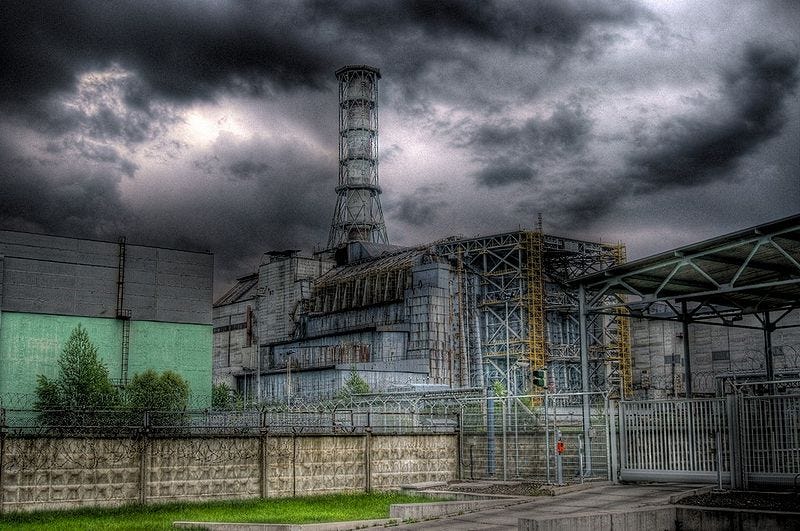
After meeting Tolik and Valya in Kiev in 1984, before I could return to further the Timezone Project, Chernobyl exploded April 26, 1986, casting doubts, fear, and radiation over the entire region.

This is Chapter 3 of a series of stories about how the Timezone Music Project evolved during a decade long pursuit of an international music collaboration between Soviet and Humboldt County, California musicians - 1982-1992.
My next trip to the USSR was in 1987, almost a year after Chernobyl. I planned to go back to Kiev and try to hook up with Tolik and Igor and their band and work on a couple songs for the Timezone Project. Months had now turned to years. As time passed, Chernobyl overshadowed the region with devastating consequences. The whole idea of music collaboration began to feel even more remote, and unlikely.
Tolik and I had written letters in Russian to each other during that time, though there were long gaps between correspondence. I kept thinking about Chernobyl when the event was churning out of control. Chernobyl was only 60 air miles from downtown Kiev, where Tolik, Valya, their family and friends all lived. That made it personal.
I wrote another letter. Several weeks later, I received Tolik’s response. Things were okay. But he didn’t say much about the disaster. He might have thought the letter had a better chance of getting though Soviet international mail surveillance if he didn’t mention Chernobyl. He looked forward to my return visit, whenever that would be.
Tolik and Valya didn’t have a phone. Internet wasn’t ‘a thing’ yet. Tolik knew I planned to come back to Kiev in 1987 from my letters, but he had no clue on what date. I would likely just show up at their door one day, unannounced.
I thought about all the good things that could develop around the Timezone Project, and all the things that could go wrong. A lot of time was passing with nothing really to show for my efforts. Everything was hinged on holding onto the dream of an international music collaboration and rekindling my connection with Tolik.
That spring day when I arrived in Kiev, I didn’t even know if Tolik and Valya would be in the city. I walked along tree lined streets, wound through neighborhoods, mostly from memory, and with the aid of a small map. And then I was in front of their building once again. Time stopped. I knocked on their apartment door, filled with anticipation.
Tolik and Valya lived in an old apartment building in the center of Kiev. Like many older apartment buildings in the USSR, they shared a communal kitchen and bath with two other families. Each family had their own one or two room apartment with a window in each room. The rooms were large and had high ceilings. The bathroom and kitchen were out in the hall in a shared area. I waited by the door. No answer.
They weren’t home.
An Era of Change
The trip back to Kiev in 1987 had taken a long and circuitous route due to changes in my life and events in the world. In the fall of 1984, after returning from two months in the USSR and first meeting Tolik and Valya, everything around me began to change. Travel had consumed my savings. Our band broke up at the end of a recording session in Humboldt County. Timezone remained a hollow dream. The music was slipping through my fingers. I felt like Tom Hanks in the film Castaway, standing at that remote crossroad in the Midwest at the end of the film, with no sure thing in his life and four roads heading in opposite directions. The Timezone Project was put on hold.
I landed a San Francisco based job a few months later though a network of friends that I could do from my remote Humboldt County home. It was business journalism, with a focus on supply chains. All I needed was a telephone, a computer, and a fax machine. I could work long hours for six weeks, then take six weeks off. That gave me a pathway to resume my pursuit of Timezone. I also finished my second oral history book - Night Crossings. It was published in 1986.
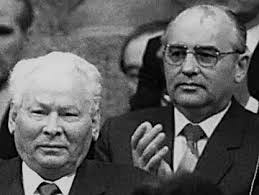
Change was also beginning to transform the Soviet Union in major ways since my last visit. Constantine Chernenko was out as General Secretary of the USSR due to failing health. He would be the last of the Soviet Old Guard. Mikhail Gorbachev was in. A new breed of Soviet leader with an eye to reform the monolithic system. Changes were moving very fast in the USSR as I followed developments in the news.
Then, Chernobyl.
On April 26, 1986 the Number Four Chernobyl reactor exploded near the town of Pripiyat, just north of Kiev. The rest is history. Deeply haunting video imagery and stories of Chernobyl were broadcast around the world. Over 800,000 Soviet people worked to extinguish the reactor fire, remove 20,000 tons of nuclear waste, and entomb the facility. The northwestern USSR had been inundated with radiation.
Estonia to Kiev
I planned my return to Kiev in the late spring of 1987. I bought a portable multi-track recording deck with an integrated sound mixer and microphones to take with me to record any possible music sessions. In the meantime, I also recorded some Timezone songs with friends in Humboldt County, even though our band was done. I’d refined a few songs and had been playing them in the studio.
Though changes were beginning to re-shape the USSR, taking a semi-professional, multi-track recording device into the country in 1987 required some fore thought and caution. It could get confiscated right at the border. The Soviet state maintained a vigilant oversight on foreigners crossing its borders. Bringing in a high tech recording system would certainly gain added scrutiny.
To lower my profile, I decided to take a ferry from Helsinki, across the Gulf of Finland, and land in Tallinn, Estonia, one of the three Baltic Soviet Republics. Finland and Estonia shared historic, cultural, and linguistic ties. The Baltic states were more independent inside the USSR and had a different history and language than Russia. I thought it might be an easier border crossing. That would prove to be wrong.
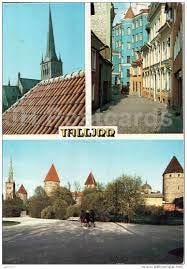
As the Helsinki ferry approached Tallinn, the northwest coast of the USSR came into view. My anticipation grew enormously. Gothic spires defined the low sprawling city skyline. It appeared more Scandinavian than Russian. As passengers departed the ferry they were screened by Soviet border officials. When it was my turn, they asked if I was declaring items. They were going to search my bags anyway, so I told them I had a multi-track recorder. That immediately got me a private room interview with a senior officer. He sat at his desk examining the portable 4 channel device with a multitude of knobs, sliders, LED’s, digital meters and other features and wanted to know what I planned to do with it?
“I’d like to record some musicians, maybe people who play in parks or on the street,” I replied, skirting the truth. I didn’t mention Timezone or Tolik in Kiev.
The Soviet officer was skeptical. He didn’t believe me. But he decided not to confiscate the recorder. Instead, he registered it directly on my USSR Visa, with a detailed description, which was attached to my American Passport. That meant I would have to show the recorder was still in my possession on my return ferry trip through Tallinn, to Helsinki. That would be in about two weeks. I planned to give the recorder to Tolik and his band. I’d worry about the border complications later.
The rail trip to Kiev was over 600 miles. I sat in my second class compartment and watched the Soviet countryside pass by the cabin window. Different passengers came and went in my four person berth. The rhythmic clacking of the rail joints beneath the car’s steel wheels punctuated each mile moving south. It reminded me of crossing Siberia by rail in 1984.
The Reunion
After a couple hours of walking around in the neighborhood and waiting for Tolik and Valya to possibly come home, they came walking down the street together toward their apartment.
When we saw each other it was pure energy. It had been two and a half years. The connection instantaneous. It was the type of feeling you experience with some people in your life when you can just step back into a flow of conversation and renewed friendship at any time, maybe years in between. But the moment you are back together, it’s like you’d never been apart.
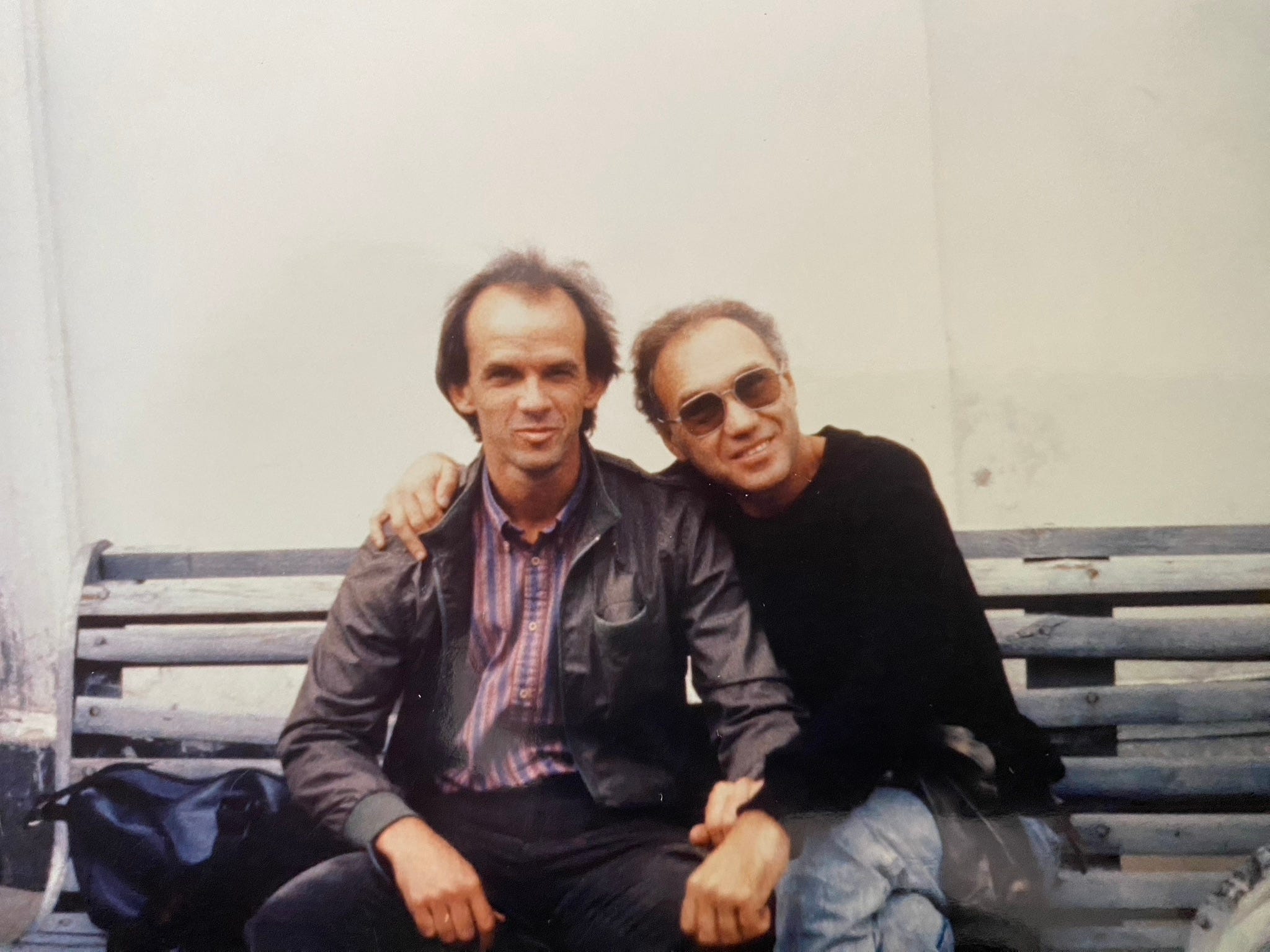
We launched into a series of visits with their friends and family. It was a celebration. Every apartment had a feast laid out on the table. It became daunting. It lasted two days. Every door that opened offered a table of food and vodka. Sandwiches, chicken, meats, cucumbers, piroshkis, vegetables, soup, rye bread, At the end of each day, I was about done for and needed to go back to my hotel to recover. All would resume the next morning.
We didn’t talk about Timezone much the first couple days, even though it was poised in my mind. I was just going with the social flow and enjoyed being back in Kiev.
On day three, Tolik said there was an overnight camping trip planned, up the Dnieper River towards Chernobyl. They wanted me to join them. It was somebody’s birthday celebration. I was alarmed at the notion to travel near Chernobyl. They said not to worry that the plant was shut down. It had been dormant for months.
I wasn’t so sure, but agreed to go. Reluctantly. I told the hotel director that I wouldn’t be back that night, that I was going camping. That was a mistake.
Despite Gorbachev’s promise of change, it was slow to filter into the day to day life. Foreigners still had to stay in government hotels. The hotel director was shocked at the notion of me camping in Ukraine under her watch. This was still the Soviet Union. All foreigners had to be accounted for.
She exclaimed, “You must be back and sleep in the hotel! Nowhere else!”
“Okay,” I lied.
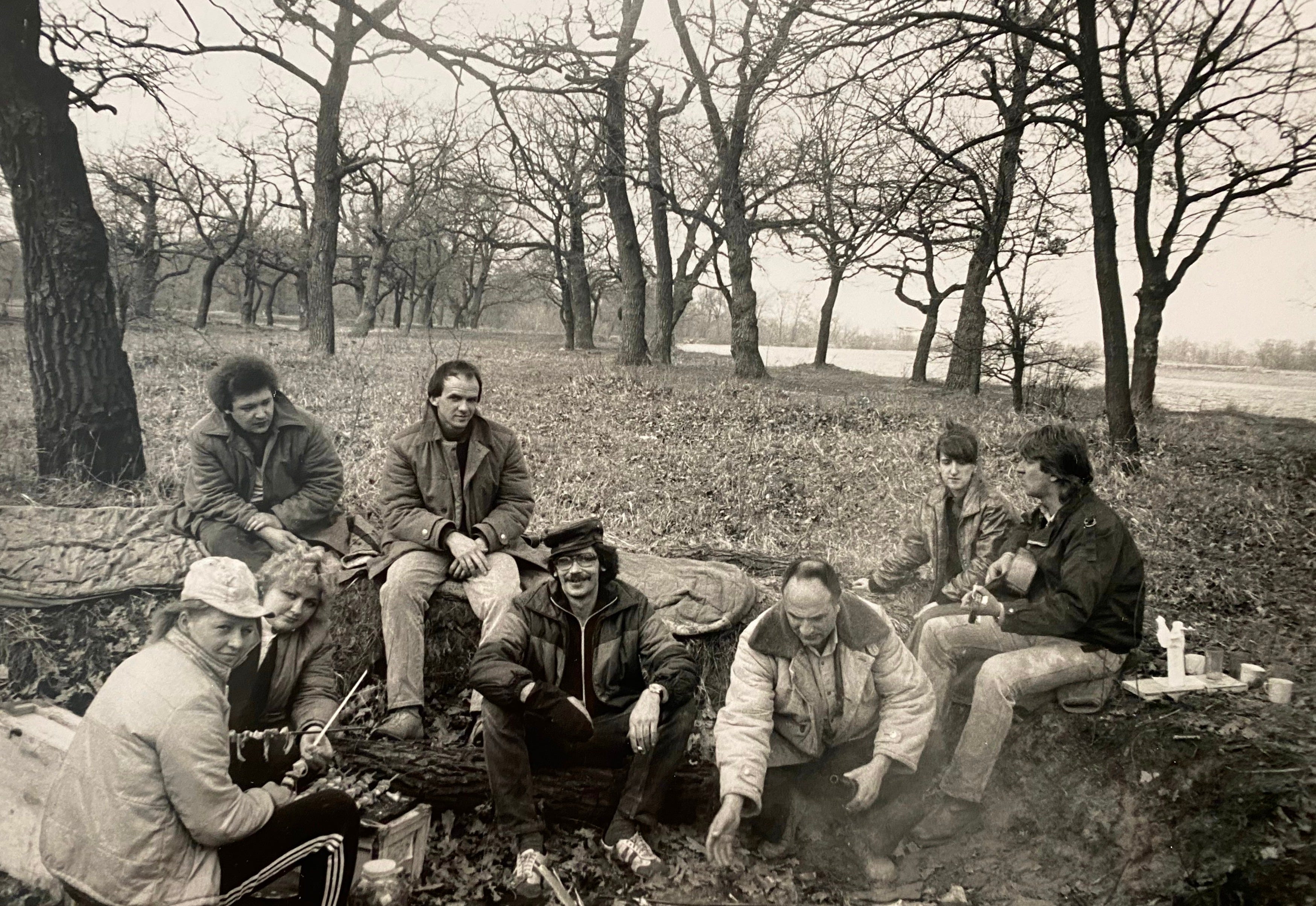
I left the hotel and joined Tolik and Valya’s group of about 12 people at a bus stop. We got on a bus and headed north, on a secondary road along the Dnieper River. I kept thinking about Chernobyl as we headed north. It seemed crazy to be driving toward Chernobyl. Nobody else seemed to care. The group had duffel bags and back packs with tents, food, vodka and a guitar. They were in a great mood, laughing and telling stories. I understood little of what they were saying.
The bus slowed as we came to a checkpoint on the highway. Police were going to come on the bus. I thought, crap, this is it. They’ll haul me off the bus and arrest me. I wasn’t supposed to be out here. The group gave me an old Soviet army jacket and put me in the middle of their scrum. They said, “Don’t talk.”
A couple of the more boisterous personalities in the group talked to the police, one was an ex-military officer. They said we were all headed out for a birthday celebration among comrades, camping! The police looked us over and let us pass their check point. I passed the visual test at least. Later, the bus dropped us off by a small village and we set up camp on the shores of the Dnieper. We had two large tents.
I don’t remember much about the food that evening, but there was a lot of vodka, laughter, a bonfire, and guitar playing as the night wore on. The next thing I knew I was waking up in the middle of a tent surrounded by people passed out or sleeping. It was well after midnight. I had to get out of the tent.
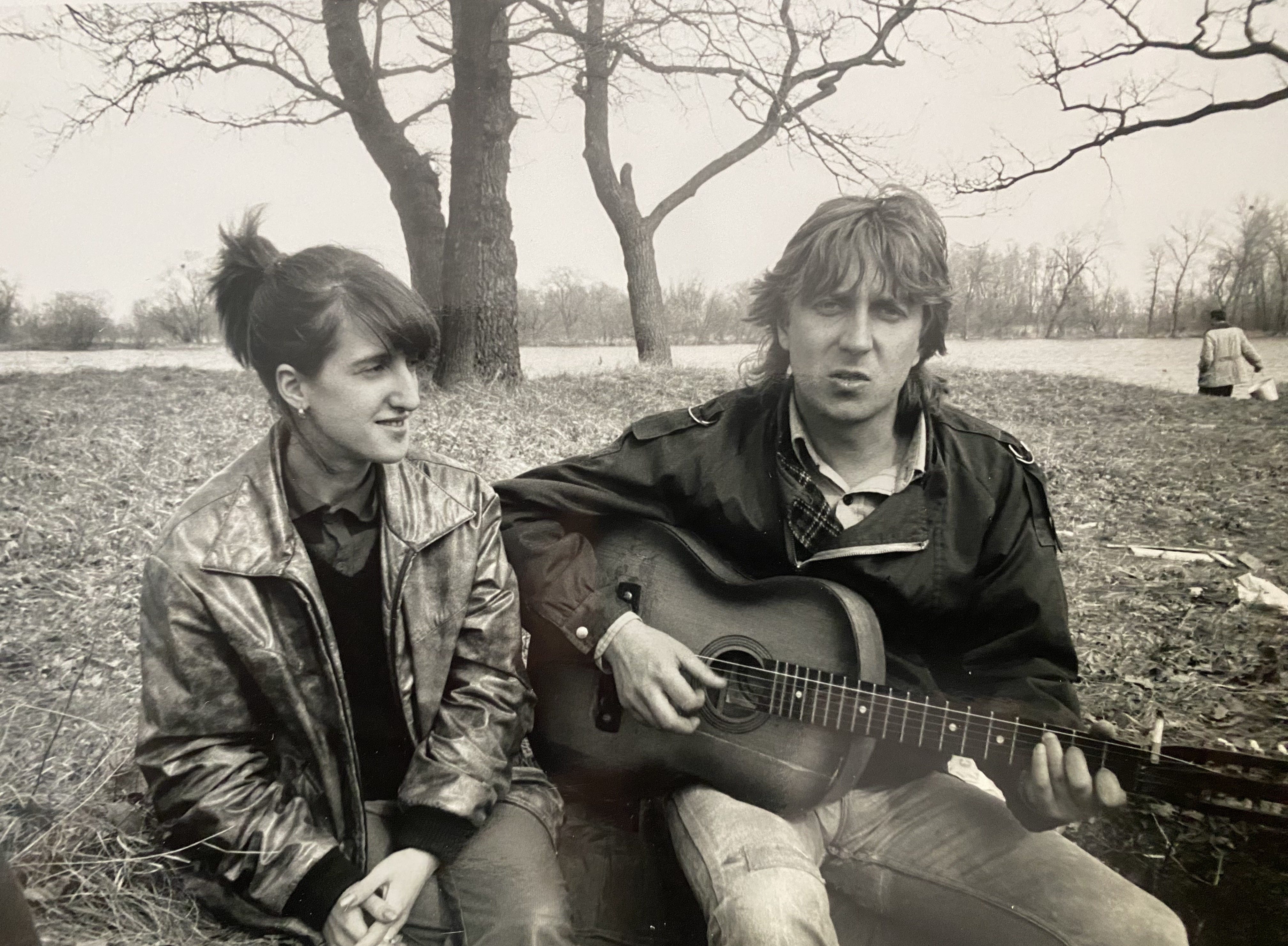
I went for a walk along the river bank. My head was spinning from the river of vodka that had flowed through my brain for a few hours. There was a small village nearby. It was probably close to 2am, but there was some lunar light so I could see the terrain. I noticed the silhouette of a man walking towards me from the north. He had a dog with him. A German Shepard. It was running around chasing a stick and came up to me sniffing. The man approached me. He was smoking a cigarette. I greeted him. He asked me if I wanted a smoke.
“Da, xochu,.” Yes, I responded, even though I didn’t smoke. Maybe it was the vodka, or just the overture of the stranger. He handed me a cigarette and lit it for me. He sensed something unusual.
“Otkuda vwee?” he asked. Where do you come from?
“California,” I replied casually, as if that would be a normal response at 2am along a river bank, near a Ukrainian village, south of Chernobyl, in the USSR in 1987.
At that moment Tolik’s sister, Sveta and her boy friend Pasha called out. They were running up the beach. They realized that I’d left the tent and was out walking around in the middle of the night, to who knows where? They caught up with me. They talked to the man on the beach and said everything was okay. I was a friend. A tourist. I sometimes wonder what that man really thought after such an off the wall encounter.
That episode became a point of repeated laughter, as people retold the story of me out wandering around in the middle of the night and meeting this village guy. “Otkuda vwee? California!”
Back in Kiev, more social interactions would happen. I was getting worn out.
On the fifth day, I presented Tolik with the multi-track recorder-mixer. And microphones. He was completely taken back by the gift. It was a total surprise. I hadn’t told him I was bringing it. I didn’t even know if I could get it across the border. I didn’t want to set expectations. He began fussing around with it. Running his hands over all the controls, the switches, the meters, the mike input ports.
I then realized this would be be more difficult than I first thought since he was blind and had never experienced this type of technology before. He said it would take him some time to discover how the system worked. I would be heading back to Tallinn via Moscow in a couple days. I had plans to spend a week in Moscow and meet a few of the people I’d met there in 1984. A lot of changes were beginning to take place in Moscow since Gorbachev came to power.
Gorbachev’s changes seemed slightly less evident in Kiev at the time, at least through the people I knew there. I greatly enjoyed my time with Tolik and Valya with their family and circle of friends in Kiev. They brought to life a very personal sense of grounding that gave me a deep sense of real connectivity and belief in the potential for Timezone going forward. I struggled though on how I could interject my sense of urgency and purpose about the project.
Tolik said they were still working on the Red Planet song translation. Maybe we could record it on my next trip to Kiev?
“Okay, next trip,” I said, with the sobering realization that another year was passing me by. The idea of Timezone still seemed just beyond reach, on an imaginary horizon.
On the train to Moscow, I just sat back and decided not to worry about it. It would happen or it wouldn’t happen.
Moscow
When I hit the streets of Moscow, the energy was ramped up, much different than Kiev. In Moscow, things were moving faster. Perhaps even faster than I could imagine.
I still had a couple Moscow phone numbers from my 1984 trip, but no plan. It was like spinning a wheel of fortune, dialing a phone number, in a public phone booth, on the street, for kopecks. See who might or might not answer the phone.
I called Layla, who I’d met through friends in 1984. She’d just finished university on that first Moscow visit. She’d introduced me to several people in the city that first time we met. Luckily, she still had the same phone number. The last time I’d called her in 1984, it was the last day that phone number would be active. She was moving to another district in the city. Phone numbers weren’t something you could count on in Moscow in those days.
She was happy to get my call. We met in downtown Moscow. “Do you want to go to the first private restaurant in Moscow? It’s interesting,” she’d said. She spoke in a quiet manner, but very direct. Her English was much better than my Russian.
The restaurant wasn’t fancy but it was thematic, with a rural Russian character and traditional Russian dishes. It was very good, and not at all like the Soviet restaurants. The service, the decor, the food, were all top notch. They served home made pelmeni, cabbage soup, borsch, piroshkis, summer salad, and an assortment of things I didn’t recognize. A very talented musician played violin at the restaurant, which enhanced the mood.
Layla introduced me to the musician and he invited us out to his country home, just outside of Moscow. He’d been a rising star in the Moscow symphony, but was exiled out of the symphony, and Moscow, after he made a critical comment about the government to the wrong person. Now he played violin in the first private restaurant in Moscow. He was encouraged about the changes that Gorbachev was bringing to the USSR.
Gorbachev had just toured Tallinn, Estonia the month before I passed through the city. His dialogue with people on the street gave hope to those who encountered him. He talked about a better time ahead, for youth and for those on pensions.
As I toured Moscow and met with more people through Layla and her friends, there really did seem to be change brewing in the Soviet capitol. The city had a certain tension about it. Everything was in motion. People were trying new ideas. Testing boundaries. Taking steps. And nobody knew where it all might lead.
I met a young guitarist, Konstantin (Kostya), who was experimenting with new music and sounds. He was involved in a couple experimental bands from the underground, meaning they were not ‘official’ Soviet bands and played only in discreet venues where independent artists gathered. He spoke English which facilitated conversations. We only met briefly because of his schedule. But he encouraged me to contact him again when I returned to Moscow.
Moscow seemed on the move and it had a harder edge to it on the streets than the congenial, welcoming I’d encountered in Kiev. Tolik and his friends in Kiev had embraced my overtures in a very personal way and given me confidence to keep moving toward the Timezone Project. Gatherings with Tolik and his friends reminded me of my hometown. Moscow would be more challenging, with its nine million people and powerful position at the center of the Soviet union.
I planned to return to both Moscow and Kiev on my next trip.
Tallinn to Helsinki
I was back at the Port of Tallinn, Estonia, waiting to engage Soviet passport control. I was headed home. I was nervous. I’d given the multi-track recorder to Tolik. Now I’d have to explain why I didn’t have the machine with me. It was all printed out and attached to my visa. I was supposed to present that machine at the border.
The wharf’s passport control station happened to be at the bottom of the gang plank leading up to the ferry deck. This was a large ship. An ocean type ferry. The Gulf of Finland could get rough. I studied the boarding patterns and watched individual passengers being questioned, some had to step aside. Others went straight up the gang plank. I decided that being a last minute, late arrival might work to my advantage. They wouldn’t let the ship go without me being onboard. I hoped.
So I hung out in the shadows by a fence counting the minutes, watching the line diminish and border control officers check their watches. The ship blew its first departure warning horn. There would be a cadence of three signals. The last blast would sound three times, for final boarding before they hoisted the gang plank.
The second two blasts resonated. The deck hands were singling up the lines. The border police were looking around for any late passengers. They were putting things away. They couldn’t see me yet. It was going to be all about timing. Just as the third and final warning ship’s whistle went off I came out from behind the wall running. The border officers were surprised. They didn’t know where I’d come from.
I hastily thrust out my papers.
The border guys were flustered. There wasn’t anytime. A senior officer approached. I handed him my papers. He saw immediately the details on the mutli-track.
“Where is the recorder system?” he ordered.
“It broke. I threw it away. It was little. It was junk.” I indicated something small with my hands. He didn’t like my explanation at all. He set a hard look at me and probably realized my last minute appearance was a ruse. But the lines were about to be cast off. The gang plank pulled away from the ship.
“Go!” he said, clearly irritated.
I was up the gangplank in seconds and on deck the ship. Headed to Helsinki. Headed home. Plotting my next trip back to the USSR. Timezone was still alive, though barely.

jhg - 1987
For more background on the initial 1984 trip - It’s Warm in Siberia
https://moonstonepublishing.com/home/books/its-warm-in-siberia/