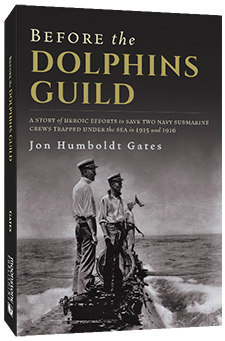
The Wild Ride Inside H-3
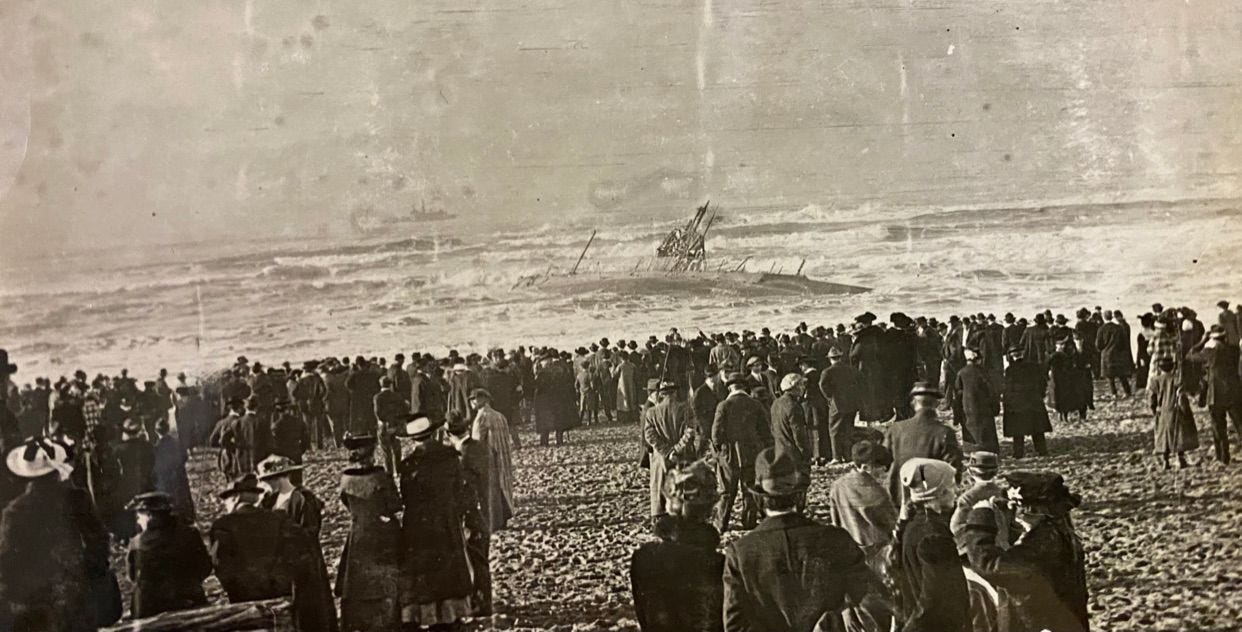
Chaos erupted inside the USS H-3 submarine the moment it crashed onto the sea bottom in the breakers, trying to enter Humboldt Bay, California in December 1916

The following event is an excerpt from the book, Before The Dolphins Guild - A Story of Heroic Efforts to Save Two Navy Submarine Crews Trapped Under the Sea in 1915 and 1916
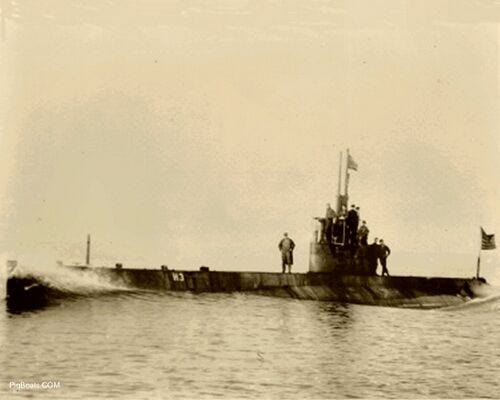
At dawn, a few sailors were up on the bridge of the USS H-3 submarine with the captain on watch. Despite thick fog and large ocean swells running, he’d decided to cross the Humboldt Bar at first light, ahead of the other two submarines in the flotilla which were coming down the coast from Coos Bay, Oregon. It was December 1916.
… Breakfast was long over. The electricians were at their control boards that were on the interior steel framing of the sub’s hull. They were about to close up the battery well after earlier troubleshooting the faulty ground connection in the after battery compartment.
A subtle motion of the boat caught Jack Agraz’s attention. Nobody else at the table noticed it much. Agraz gazed around and listened. “That was different,” he said.
When Jack Agraz spoke, everybody listened. He knew a lot about subs and the sea. He’d been aboard them for years. He’d been up and down the coasts of China, Japan and the Philippines aboard ships from the US Asiatic Fleet.
Jack dove while he was in the Asiatic Fleet. He kept a handwritten diary from those days, listing all the ports he had sailed in and out of and all the ships they had encountered. He’d write about big storms, who fell overboard at sea, where they dropped anchor, took on coal or how much he got paid extra for diving.
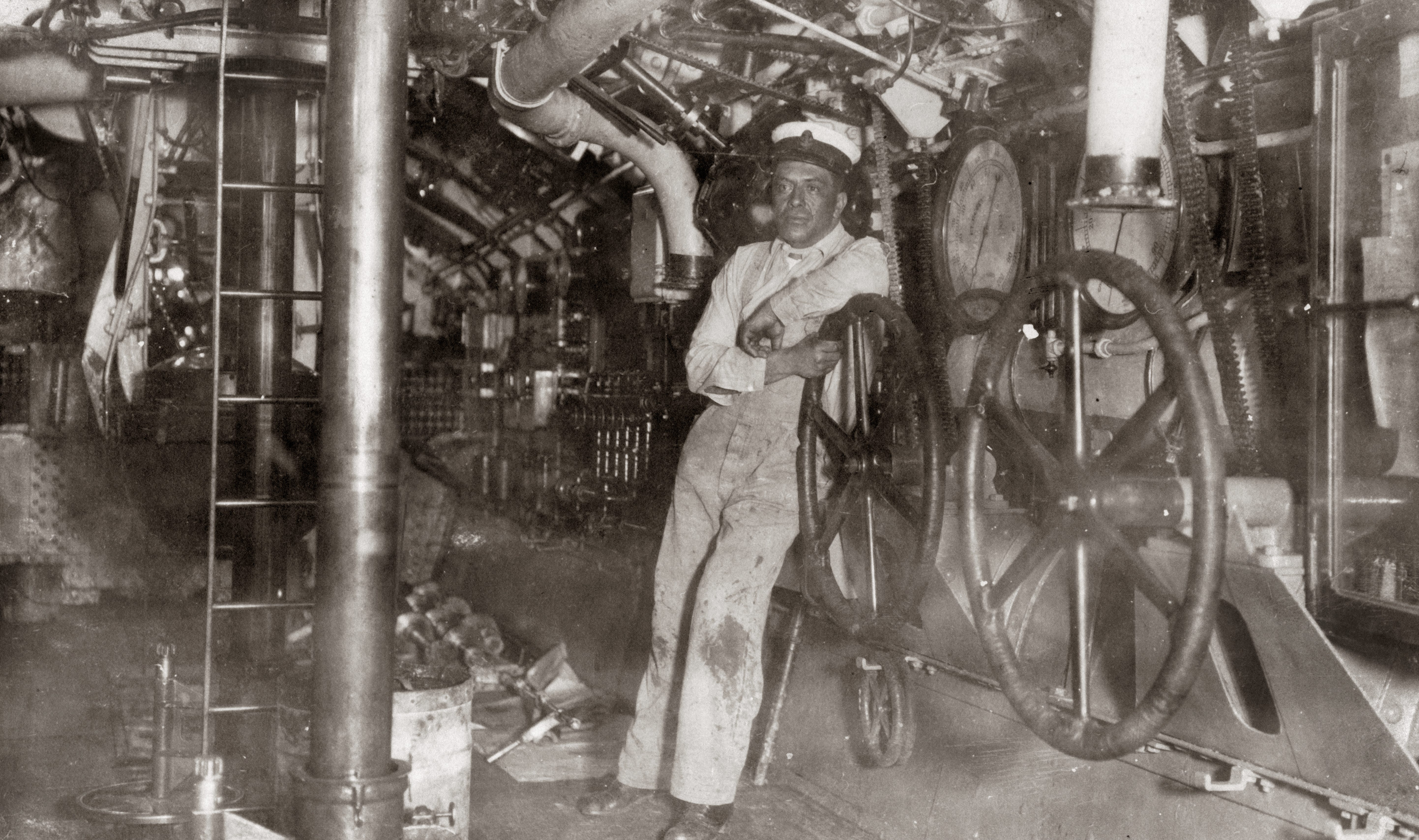
But it was his stories about the F-4 incident in Hawaii the previous year that would send chills down the spines of younger crew members. Along with Jack Agraz, Lt. Bogusch had been deeply involved in the F-4 incident as well. They could recall the tense moments of those days off the coast of Honolulu.
“There’s change in the boat action,” Agraz said, standing up. “That felt like a corkscrew. Boys, trice up the table. The seas are getting restless.”
Right after the chief remarked about the boat’s action, just before 0830 hours on December 14, H-3 was lifted by another enormous wave, bigger than the rest. A sneaker. The submarine hung on the crest, beginning to tilt forward. Everybody could feel it. Conversations halted. The sub pitched down the front of the cresting swell, gathering speed and steepness. Tobogganing. Then the steel structure of the boat shuddered as it hit bottom. A second breaker was right behind the first.
The chief felt the sub starting to broach on the first wave as the stern swung from the wave’s force. Then with a tremendous push, the second breaker hit. The sub suddenly rolled hard on its starboard beam. Men, mess gear, mess benches, and all the loose gear in the compartment were smashed up against the lockers on the starboard side. Saltwater cascaded down through the main hatch. There had not been time to close it.
Crew members tumbled to the deck, entangled with each other and the loose gear. Duane Stewart landed face down with his coffee cup still clenched in his hand. Jack Agraz right next to him. Circuit breakers blew. Fuses blew. Electrical pops and small explosions were followed by flaming arcs that jumped from behind the boat’s electric panels. Insulation caught fire.
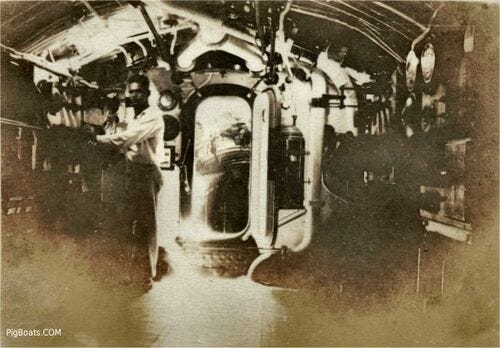
Smoke began to form inside of the boat. A small fire broke out in the engine room bilges. The exposed batteries caught fire in the terminal cells. Saltwater rained down through the open deck hatch. A hint of chlorine gas started to stir from the battery cells. H-3 had hit bottom full force crossing the Humboldt Bar. At least that’s what the crew thought.
Duane Stewart toppled over, making frantic grabs for the swinging table. But it wasn’t there. Electrician’s Mate J.B. Rollins and Chief Electrician Jim Anderson were both just coming through the control room door. They tried to grab the door edge. They missed and came hurtling into the mess. At the same time, a large pot of pancake batter was jarred from its rack. The pancake batter and cook flew through the air and landed on top of everybody.
Back in the engine room, Chief Machinist’s Mate Steve Galazitas was having a time of it. There was a lot of smoke. They needed fire extinguishers. The engines were already shut down, but debris and water got into the electric motor armatures when the boat rolled hard over, causing shorts and heavy arcing. Electricians were trying to contain the fire. Both drives had to be shut down immediately to prevent a disastrous fire.
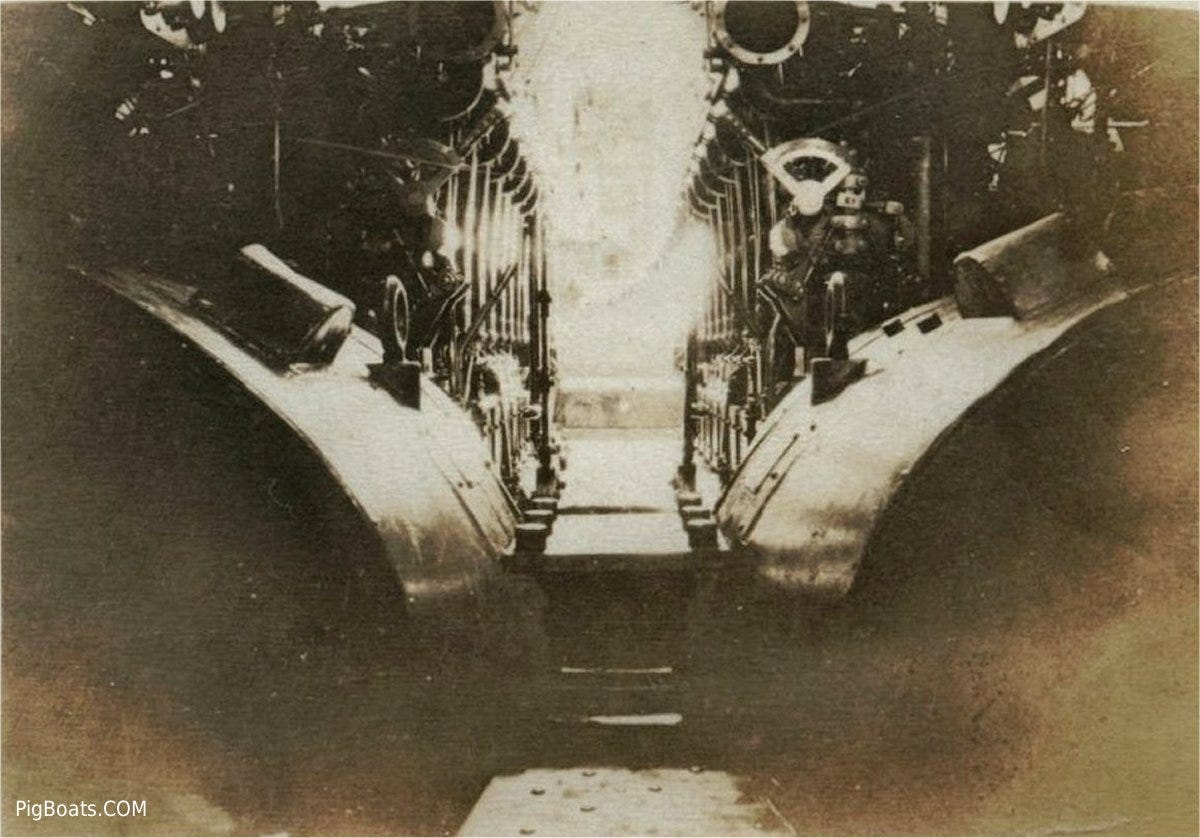
Smoke drifted heavily from the forward battery compartment. Saltwater sloshed around on the inside decks above the battery tanks. The sub stayed on its starboard side about 10 seconds. That was it. Another ground breaker lifted H-3 and dropped it hard on the sea bottom. Stewart felt like he’d just jumped off a 10-foot roof from the impact. This time the sub landed on an even keel. That gave the crew time to get untangled and back on their feet. They immediately secured benches and the table to the overhead framework.
They had just moments to survey the damage before another swell lifted the sub up and pounded it. The impact reverberated through the hull structure. This time it rolled over onto the port side. Several panels of the cork lining were jarred loose and joined the debris already sloshing around from side to side in the saltwater that had come through open hatches and ventilators. Stewart could see there was seawater in the control room, too.
The waves kept coming. Saltwater came down through the conning tower hatch and forward battery compartment ventilator. The ventilators were open for a smooth surface run. Not for taking breakers over the top of the sub. Or rolling over in the ocean. A crew member made a dash for the steel ladder leading to the main hatch in the after battery compartment. But before he could get the hatch closed, the boat rolled again. More seawater sluiced through the hatch, knocking the sailor off the ladder.
A second crewman made it up the ladder. He secured a solid grip on the main hatch and brought it down with a heavy clang and spun the locking wheel, securing the seal. That stopped the seawater from entering the aft battery compartment. But the damage was done. Everyone just held on.
With each roll, sailors reached for pipes or any secure handhold to keep from slipping and sliding side to side. Stomachs went hollow. At times the boat rolled in excess of 60 degrees. The compartments were tinged with smoke and acrid fumes of burned insulation and smoldering cloth. One sailor called out, “Chlorine gas!”
With the first roll, Duane Stewart thought the acid must have sloshed out of the lead-acid battery cell tanks below deck and forced its way around the edge of the rubber covering over the planks. The battery tanks were situated beneath the forward and after battery compartments. Duane was standing directly on top of the after battery tank, and part of it was exposed from the electrical work that had just been completed.
The boat had 120 cells in the forward and after battery tanks below deck. The cell structures contained more than 2,000 plates of active lead material and 1,800 gallons of sulfuric acid. The entire battery system weighed more than 130,000 pounds. And it could become a bomb if hydrogen gases were ignited.
Chlorine gas was the big worry at that moment for Duane Stewart and the rest the crew. If seawater came in contact with battery acid, it would form a yellow-green cloud of chlorine gas and settle in the lowest part of the boat. It was heavier than air. It could be extremely noxious and deadly, even in small concentrations. Duane wasn’t as worried about the hydrogen gas. It was odorless and colorless, lighter than air and extremely explosive. But that was a by-product of charging the batteries with the engines. The engines were shut down.
The battery tanks were topped off with sulfuric acid to within three inches of their tops. The tanks were designed to take a 20-degree roll without discharging any acid into the lead-lined tanks. The sub had just taken a 60-degree roll. Incoming saltwater began to mix with the battery chemicals. Duane thought they might have chlorine gas mingling in the compartment. Deep down, he knew it was his fear causing that reaction. But the chlorine odor was there and starting to spread.
This is an excerpt from one chapter in, Before The Dolphins Guild - A Story of Heroic Efforts to Save Two Navy Submarine Crews Trapped Under the Sea in 1915 and 1916
https://moonstonepublishing.com/home/books/dolphins-guild/