The Unpredictable Humboldt Bar
It's taken a century for the Army Corp of Engineers to gain control over the entrance to Humboldt Bay, though it still remains a daunting challenge for mariners

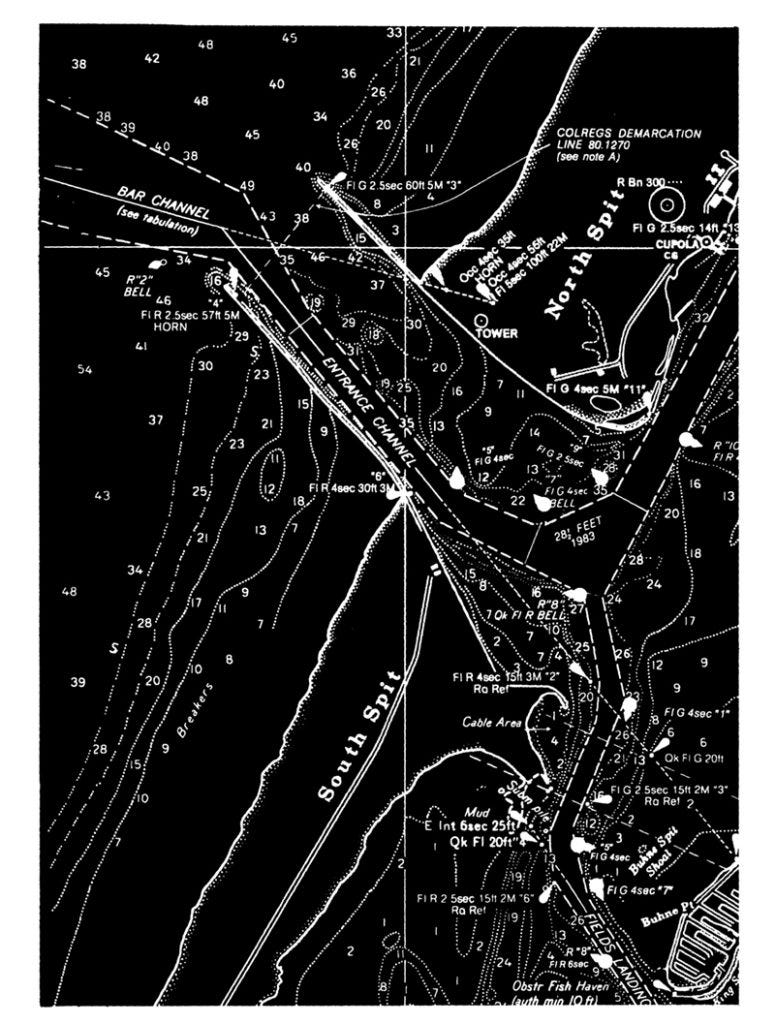
The Humboldt Bar ·“Humboldt Bay can be used as a harbor of refuge in impending bad weather, providing a vessel can get inside before the bar becomes impassable.”–UNITED STATES COAST PILOT - PACIFIC COAST–12th EDITION
JETTIES & DOLOSSE
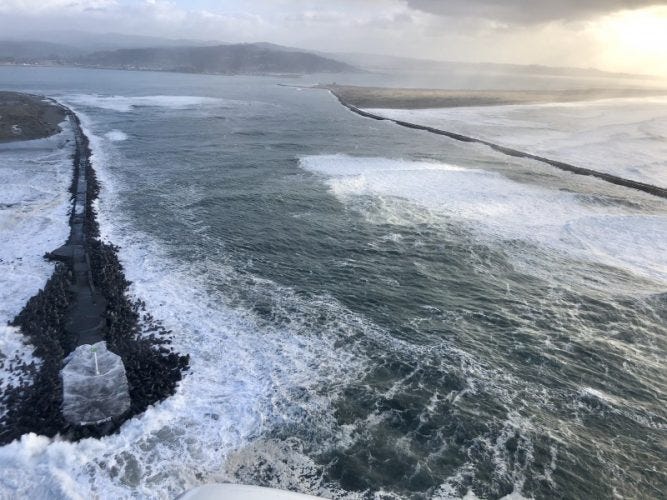
The north and south jetties on Humboldt Bay’s entrance each measure over a mile in length from the inner harbor seawalls to their outermost exposed ends. These multi-million-ton structures were initially built out of quarried rock by the Army Corps of Engineers in the late Nineteenth Century. But within twelve years of their completion, the ocean destroyed whole sections of them, virtually obliterating their ends and burying them under tons of sand.
Army engineers re-built the jetties, installing a thousand-ton monolith of steel-reinforced concrete at the end of each structure. Boulders weighing up to twenty-one tons each were placed around the monoliths for armor protection. This was completed in 1925, but five years later, extensive repairs were needed.
In 1932, concrete blocks weighing over 200,000 pounds each were placed along the breakwaters for added protection. The ocean washed most of them away the following winter.
For the next three decades, Army engineers continued their stonewall defense by hauling thousands of tons of rock, steel, and concrete out to reinforce the ends of the jetties. More 200,000-pound concrete blocks were installed.
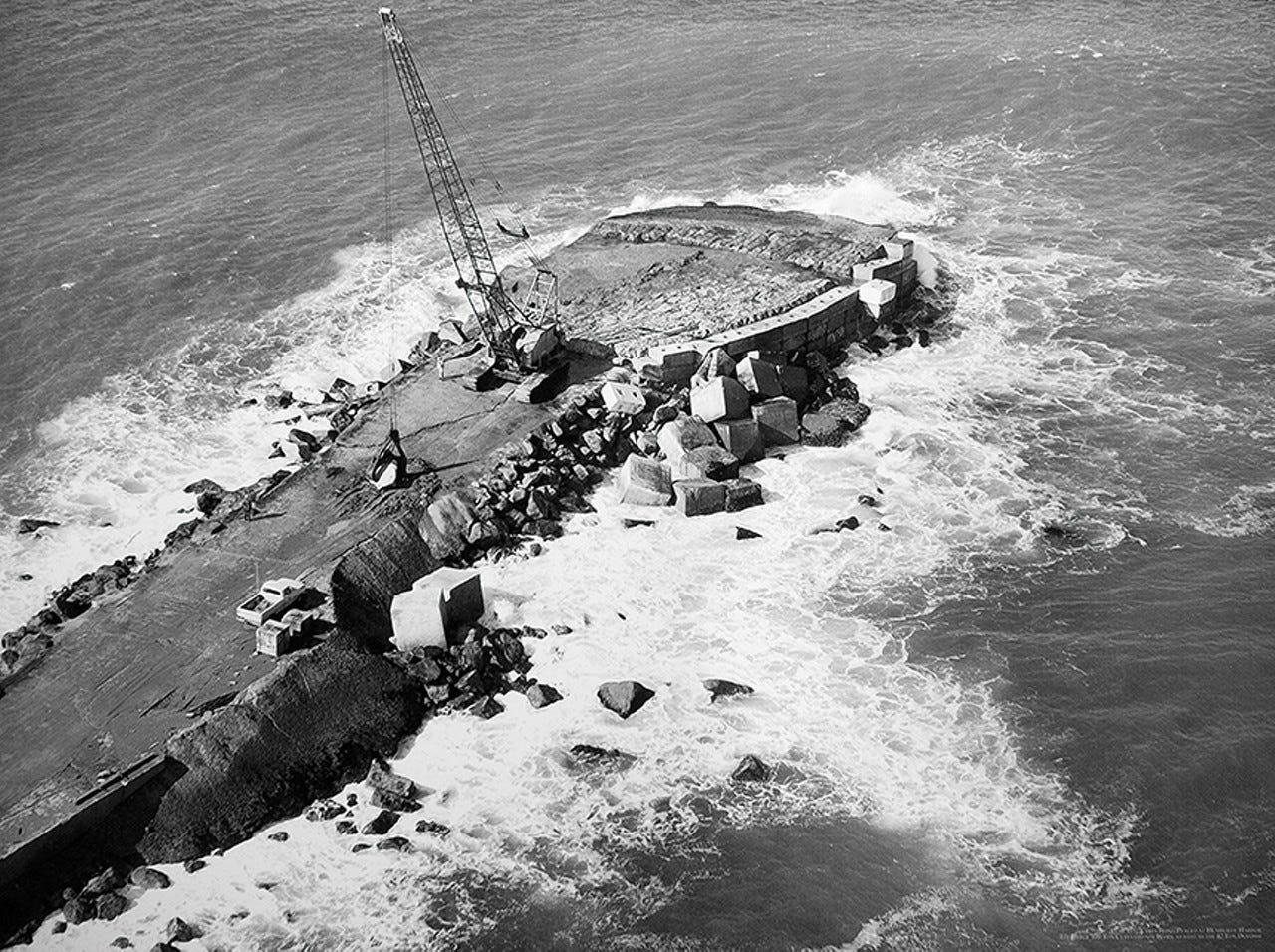
In the 1940s, scores of 24,000-pound tetrahedrons were placed on the jetties. The stubby three-legged cement devices were the prototype of new breakwater designs being explored by engineers. But by 1969, storm waves and foundation erosion had once again, totally destroyed the ends of the jetties. Most of the 200,000-pound blocks had disappeared.
Army engineers needed a new wave defense strategy for the Humboldt Bar.
In 1970, they introduced the dolos—a breakwater module which based its effectiveness on passive resistance to wave force. The dolos was invented in South Africa by the Port of East London’s harbor engineer. In its native Afrikaans language, dolos means the ankle bone of a small goat. For years, the rural Afrikaner children had played games with the small bones.
The dolos module is an abstract, concrete sculpture patterned vaguely after the goat’s bone. It also resembles an old sailing ship’s anchor, except it is much bulkier. The dolosse (plural) weigh forty-two tons each and stand about twelve feet tall. The original South African model was much smaller. A forty-two ton dolos had never been built prior to the Humboldt Bay jetty project.
The surface area of the dolos is made up of elongated octagonal facets which taper at each end. No large area exists for a wave to hit. Dolosse are designed to interlock with each other and form a deep labyrinth of small open spaces and angled surfaces to dissipate and deflect wave energy. In effect, the jumbled maze of concrete transforms megaton breakers into small wavelets.
Five thousand dolosse were placed around the ends of Humboldt Bay’s north and south jetties during 1970. In the fall of 1985, Army engineers returned to the jetties to conduct more repairs. This time, the structures were completely intact and repair work was minimal compared to previous years.
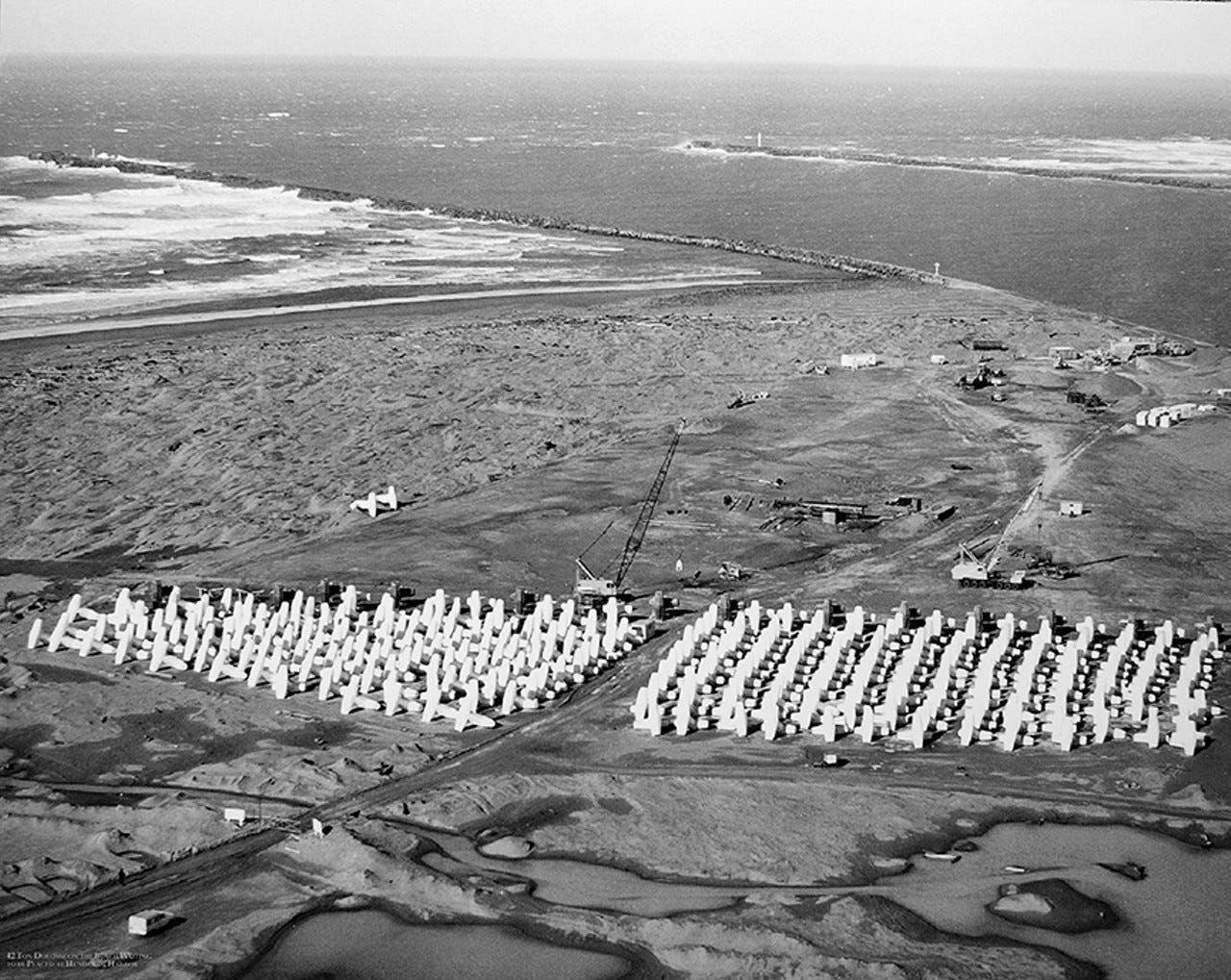
The dolosse had proven a tremendous success. After fifteen winters, only four of the original modules had been broken. Underwater erosion had caused the only severe breakwater damage. Several thousand tons of quarried rock were deposited into these eroded areas. Engineers also bolstered their defense with another one thousand dolosse around the ends of the jetties.
In recognition of the Army Corps of Engineers’ century-long battle with the sea, the Humboldt Bay jetty system has been designated a National Historic Engineering Landmark.
THE VARIABLES
TIDES
Tides create the most colossal movement of water on the Humboldt Bar. In a twenty-four hour period, two complete tidal exchanges occur. In that time, lunar gravity will move a quarter of a billion cubic yards of sea water through the harbor’s half-mile wide entrance. If that amount of water were placed in five-gallon buckets lined up next to each other, the buckets would reach from here to the moon and back again five times.
At maximum high tide, Humboldt Bay covers twenty-four square miles. A large springtide runoff can drain the harbor to nearly half that size in only five hours. Bay water levels can drop as much as ten feet in that time. Ebb tide pours across the bar at three to five knots, discharging 100,000 cubic feet of sea water per second and twelve million tons per hour. At that rate, it would take only five minutes to fill ten thousand cement swimming pools.
Constant pressure flow between the two jetties reaches nearly two million pounds of force. Before the jetties were imposed on the bay, this powerful flow used to randomly shift its course, moving the entrance a mile and a half up or down the sandy peninsulas which it split.
CURRENTS
The ends of the jetties are virtually a street corner at a busy inter- section of water. Waves roll in from the west, ebb tides pour out of the harbor from the east, and a variable cross current moves either north or south in a perpendicular flow to the bar. Coastal winds cause the variable currents.
The prevailing north- westerlies move the current toward the south. Southerly winds send the current in a northerly direction. These currents hug the coast and move across the outer ends of the jetties at two to four knots, depending on wind force.
SHOALS
The Humboldt Bar’s sandy bottom is constantly shifting. This varying condition is caused by themovements of tides, currents, and two nearby rivers. During the North Pacific’s heavy winter rains, the Mad River and the Eel River send millions of tons ofsilt down to the sea. On a record day in January 1980, Eel River emptied two and a quarter million tons ofsilt into the ocean. The river was flowing at a sustained high water mark after a large rainfall.Coastal currents move some of this silt toward the Humboldt Bay entrance. Several hundred yards offthe end of the northjetty, a huge deposit of river silt permanently sprawls over a square mile of oceanfloor. Tides carrythe silt in dense clouds across the bar and into the harbor. On a calm day in betweentidal movements, a diver’s visibility is about two feet.Army engineers dredge a million cubic yards of silt a year out of the 500-foot wide entrance channelthat runs along the south jetty. The channel’s depth is about forty feet. The rest of the half-mile wideentrance bottom is left undredged. Its depths vary from seven to twenty-five feet. Breakers frequentlysweep these shoaled areas.
FOG
During the warm season, fog can smother the coast for weeks.This dense atmospheric condensation is usually caused by warm in-land continental air rising and cooler offshore ocean air blowing in toward land from the Pacific High—a semi-permanent air mass that sits several hundred miles offshore during the summer. The Pacific High generates northwesterly winds which blow down the coastline and cause upwellings of icy sea water. When the offshore air passes over the cold zone near shore, the wind’s moisture is refrigerated into fog.
THE UNPREDICATABLE
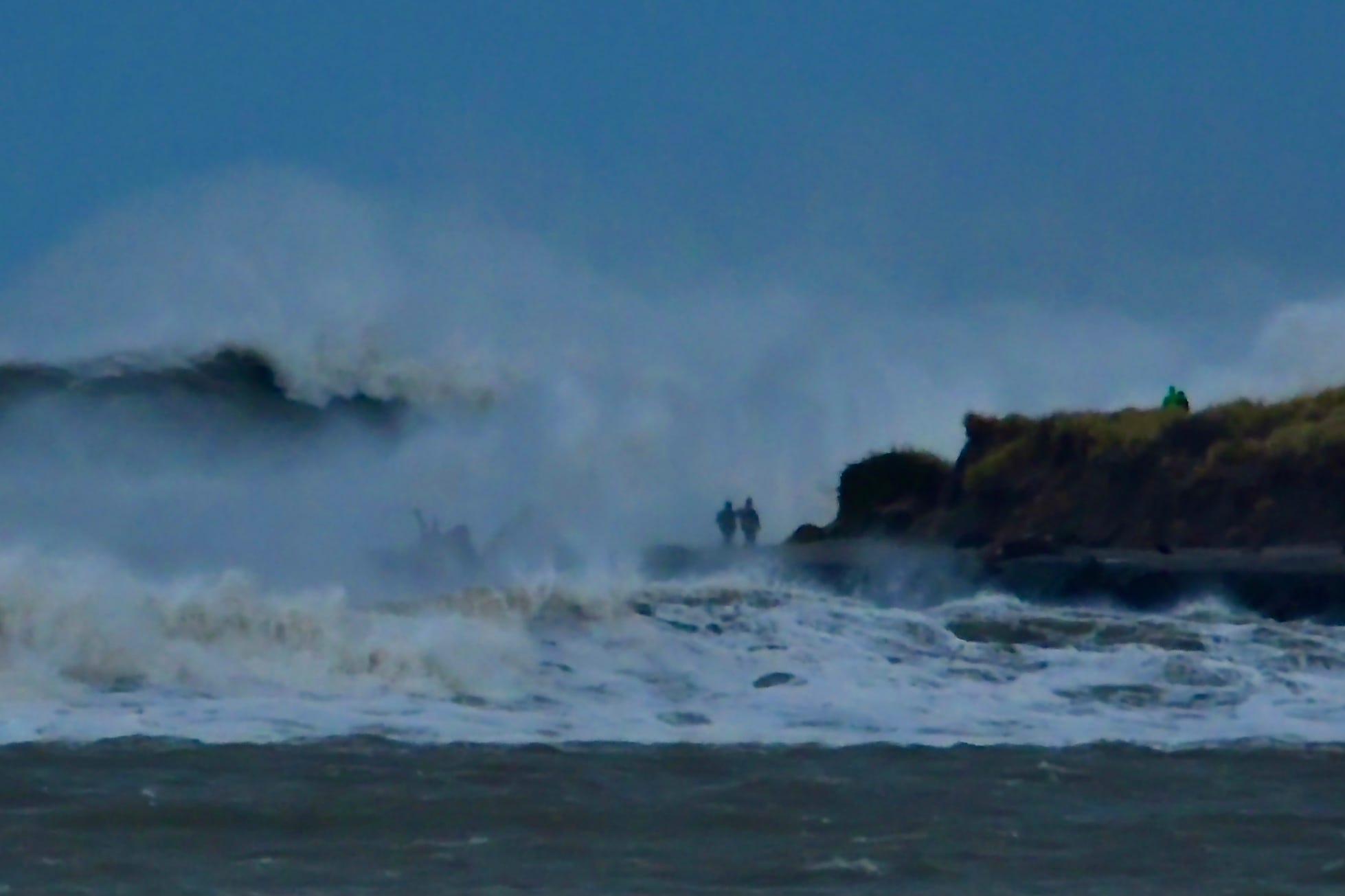
Most waves are born from the wind’s energy. Offshore storms sweep over thousands of square miles of open surface water, kicking up confused waves that intermingle, engulf each other, and move at different speeds. These movements are called seas. When the waves move out from under the wind and begin to travel long distances, they are called swells.
A powerful South Pacific typhoon might drive swells over a distance of six thousand miles before they reach a shore in the northern hemisphere. A single fifteen-foot wave that passes over the Humboldt Bar and between the two jetty heads moves with a force of more than sixty thousand horsepower. If that energy were harnessed, it would create enough electrical power to light fifty thousand homes.
Such a wave carries extreme destructive capabilities. A fifteen-foot breaker can hit a single square foot of solid surface with twelve thousand pounds of force. When the breaker’s size doubles, its destructive power becomes four times greater. In Wick Bay, Scotland, in 1872, a series of successive storm waves carried a 1,350-ton concrete, rock and steel jetty head off the structure’s foundation in one piece and dropped it into the bay. Engineers rebuilt the monolith. The new one weighed 2,600 tons. Five years later, storm waves wrecked that one too.
Storm waves often have a rhythm to their size. Perhaps every twenty to thirty minutes a large set arrives. Since the speed of ocean swells varies, some of the swells overtake others and combine their energy to become superwaves. The probability and height of these wave fusions are impossible to predict.
One of the most phenomenal superwaves in recorded maritime history occurred on New Year’s Eve of 1914, at the Trinidad Head Lighthouse just twenty miles north of the Humboldt Bar. A storm had been building along the coast for four days. Keeper Fred Harrington was standing in the lens tower at sunset when he noticed a monstrous wave approaching the 175-foot high bluff where the light- house stood.
After a tremendous impact, the sea washed over the top of the bluff and buried the light tower up to its lens, a height of 196-feet above sea level. At least one historian contends that the wave at Trinidad Head was a tidal wave, generated by an underwater earthquake. But most published accounts of the event list it as a storm wave. Over the years, several of the more exposed lighthouses along the Pacific north- west coast have reported freak incidents of superwaves that have exceeded one hundred feet.
Author’s note - this description of the Humboldt Bar appears at the end of my book Night Crossings - Five true stories that happened, between 1933 and 1982, when mariners encountered rogue waves emerging from the dark of night, while crossing the Humboldt Bar.
The book also includes a partial list of historical shipwrecks on the Humboldt Bar (below). That list does not include the scores and scores of smaller vessels that have been lost on the crossing, including four of the boats that sank in Night Crossings.
SHIPWRECKS ON THE HUMBOLDT BAR
* List edited from Marine Disasters of the Humboldt-Del Norte Coast - Complied by Wallace Martin - 1975
1850 - San Jacinto - Schooner
1851 - Jane - Barkentine
1851 - Susan Wardwell - Schooner
1851 - Commodore Preble - Steamer
1852 - Sea Gull - Steamer
1852 - Cornwallis - Barkentine
1852 - John Clifford - Steamer
1852 - Home - Barkentine
1853 - Mexican - Schooner
1854 - Sierra Nevada - Schooner
1855 - Piedmonte - Schooner
1856 - Toronto - Schooner
1858 - J. M. Ryerson - Schooner
1860 - Success - Barkentine
1862 - T.H. Allen - Barkentine
1863 - Aeolus - Brigantine
1863 - Merrimac - Steamer
1864 - Hartford - Barkentine
1872 - Spud - Schooner
1875 - Willimantic - Barkentine
1876 - Albert & Edward - Schooner
1877 - Marietta - Schooner
1878 - Laura Pike - Schooner
1880 - Edward Parke - Schooner
1885 - Annie Gee - Schooner
1888 - Mendocino - Schooner
1889 - Fidelity - Schooner
1899 - Chilkat - Steamer
1899 - Weott - Steamer
1906 - Newsboy - Steamer
1907 - Sequoia - Steamer
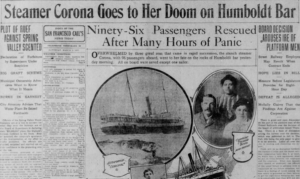
1907 - Corona - Steamer
1916 - USS H-3 - Submarine
1930 - Brooklyn - Steamer
1931 - Cleone - Steamer
1932 - Washington - Steamer
1933 - Tiverton - Steamer
1933 - Yellowstone - Steamer
1941 - Katherine Donovon - Steamer
1962 - White Cloud - Steamer
1963 - Lumberjack - Barge