Ode To White Rim
A Five Day Mountain Bike Trip Through Canyonlands National Park's 100 Mile White Rim Trail Proves Exhilarating
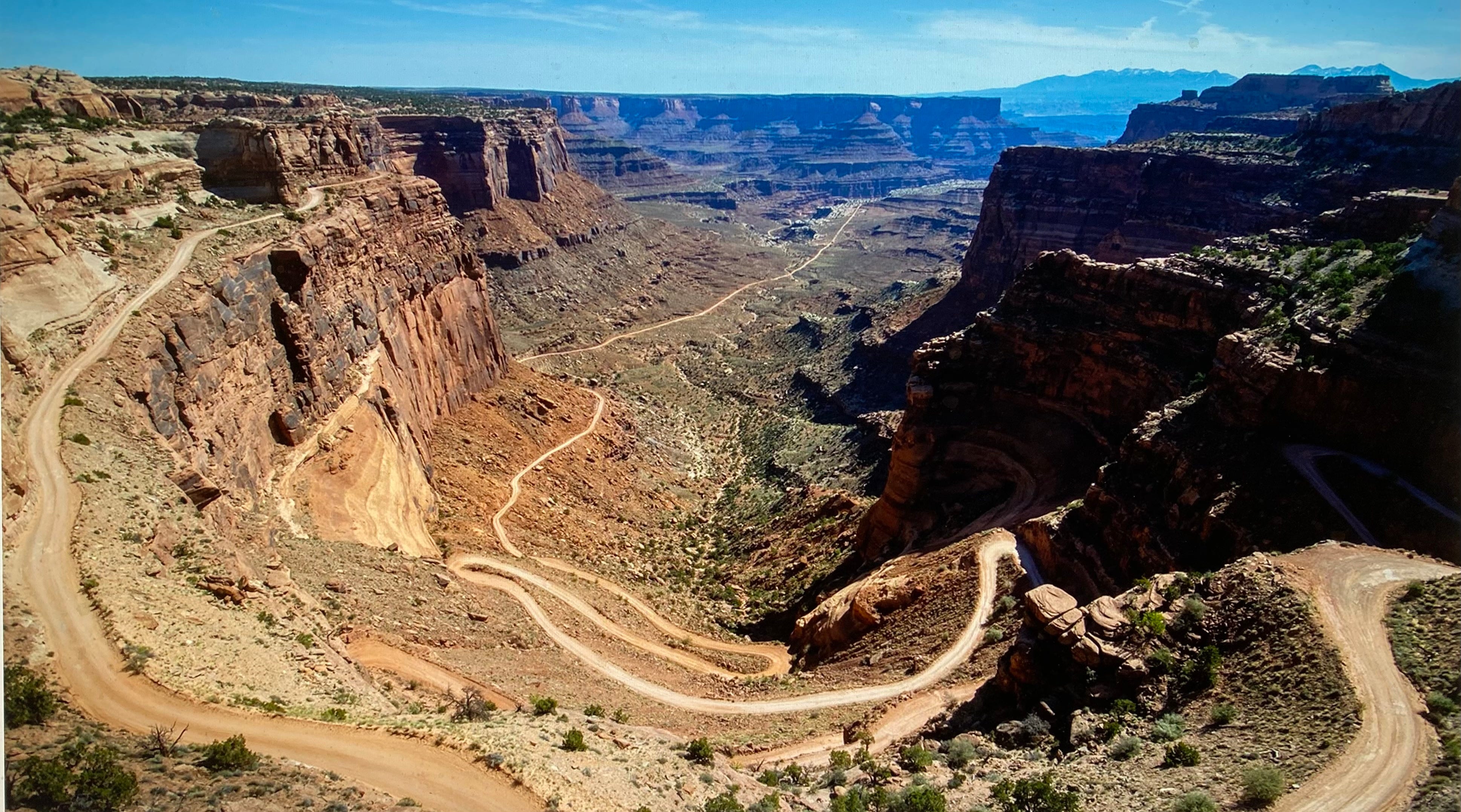
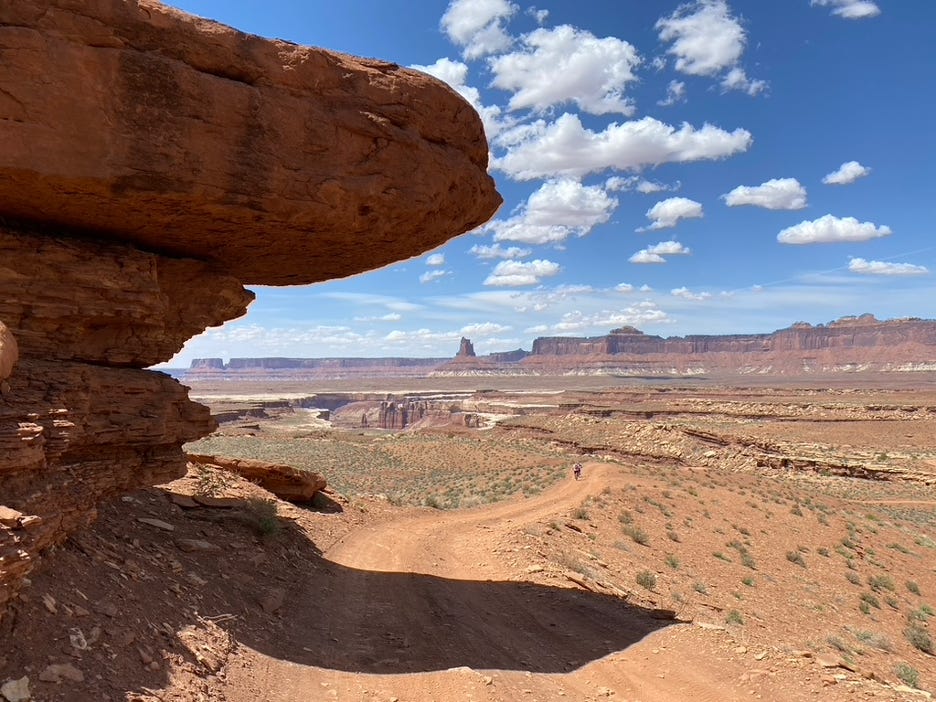
Descending the 1,200-foot Schafer Trail drop on a mountain bike, down to the White Rim Trail head in Canyonlands National Park, you feel as though you are plunging into a void. Your stomach hollows when you look over the edge. As you negotiate gravelly switch backs and sharp drops, edging down sheer sandstone walls on a narrow road, first cut by cattle ranchers over a century ago. You realize that you are entering a place of transformation. All time, social relevance and human scale diminish. You become a spec. Smaller and smaller, the deeper you descend into the formation.
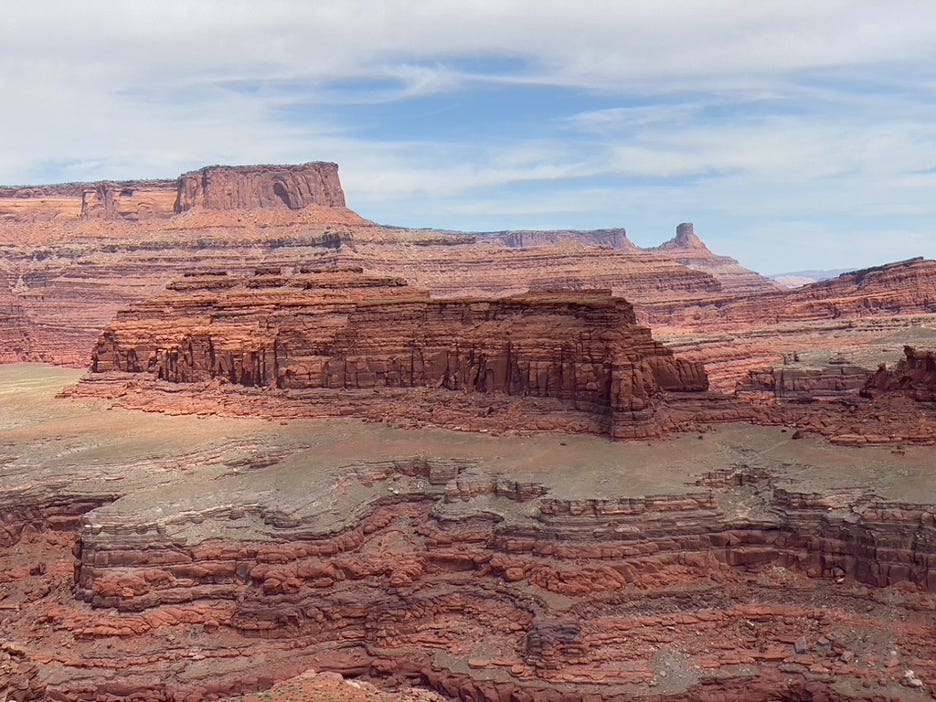
There is no cell signal, no water. You live on what you can carry for the next five days and 100 miles. You could disappear in this vast dry landscape, a world of geologic layering that registers epochs in terms of 10 and 20 million-year intervals, layering down through seabed, limestone, sandstone periods of time that date back 200 million years. To the trained eye, you can see sediment layers in the sandstone walls where the ancient ocean shores washed upon beaches, one eon after another. You can only imagine what kind of sea monsters swam in these waters, in these deep submerged canyons.
This is a place where people just pass through, but can’t afford to stop, for fear that supplies will run out. Even the indigenous people of the high desert, the Utes and Navajos, could not sustain in this vast outcropping of stunning rock formations and ultradry conditions where the winds can kick up to 60 miles per hour in a second and blast the rock surfaces and any living person, with a fury of sand. The wind is one of the natural forces that have shaped this stunning landscape. Ice, water, and time have also carved the land.
A few mountain sheep eat the spring grasses, extract water and nourishment from the shrubbery. They have discovered discreet, rocky passages, down hundreds of feet of loose boulders and rock through the cliffs, to the Colorado River below. But even the shrubs will dry up into the summer. Lizards have carved a niche, a few scorpions, snakes, and birds, especially along the western flank of the White Rim where the Green River flows mightily, carrying the snow melt from the Uinta Mountains and Rockies in the north.
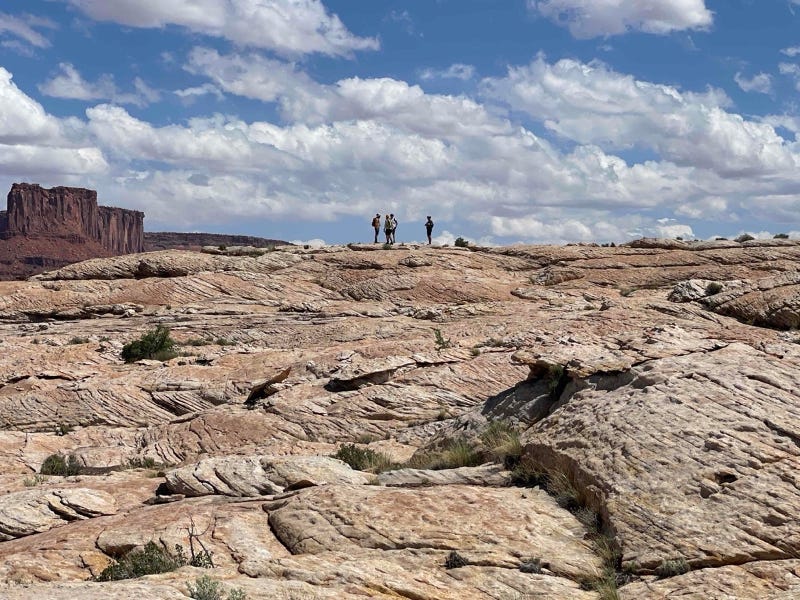
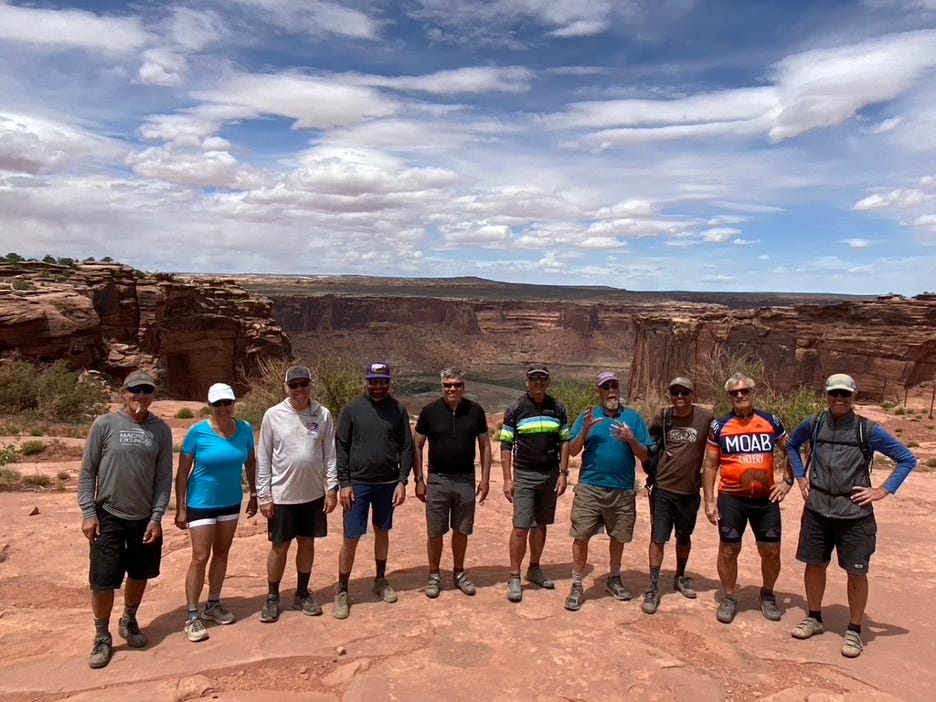
You are always reminded how small you are, on the White Rim. How short your perspective of time is. You just stand there with a few friends who have ventured into the outback with you, mesmerized by the vast layering of rock and sand, and a majestic blue sky that stretches in every direction, horizon to horizon, clouds fluttering in its expanse, giving welcome breaks from direct sun rays. You see your friends from afar and realize just how small we’ve become in this ancient seabed.
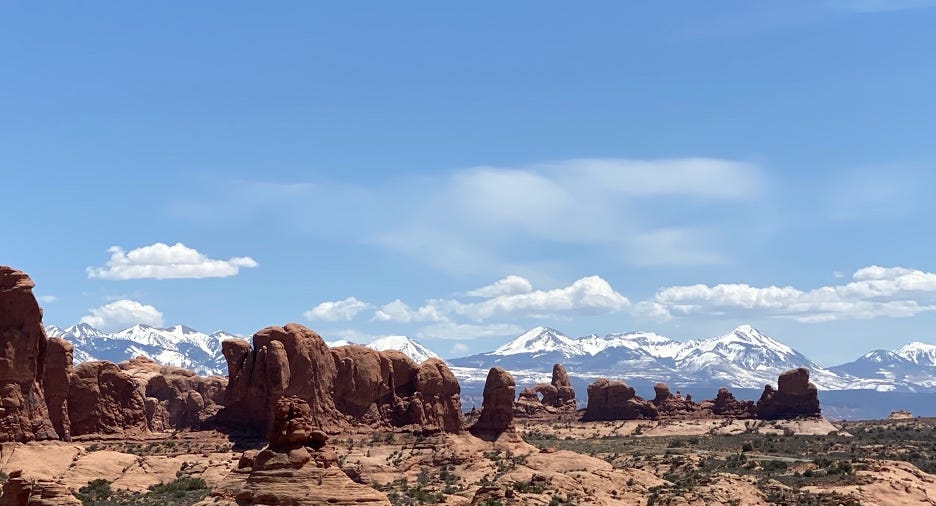
To the east, in the distance, the majestic snow cap of the La Sal Mountains rise dramatically above red rock escarpments, some of the La Sal peaks soaring over 11,000 feet. The La Sal’s alpine forests, snow crests, and high mountain lakes surrounded by green grasses, defy the desert dryness and heat that surrounds them. They are an oasis in the drylands.
There are few signs of civilization in this outback country, other than recently constructed pit toilets, a rough gravel, sand, and rock road, and a few signposts. Some rotted remnants of a cattle fence and a few indigenous outposts, carved out of the rock by another culture long ago. These appear as temporary habitats, never a sustaining presence.
The trail pitch, at times, can climb 25 degrees, with your rear bike wheel spitting out rocks and sand, until you are forced to walk. Only the top bike riders can sustain the grueling, final pitches up Murphy’s Hogback and Hard Scrabble. Our guides show us how it’s done while we walk the final precipitous climb to the top. This is the second time we’ve ridden the White Rim Trail with Maggie and her Magpie Cycling guides. They know the terrain, the biking techniques, the old stories, the outdoor grill recipes, the natural history, the indigenous ways. And they impart that knowledge all along the way.
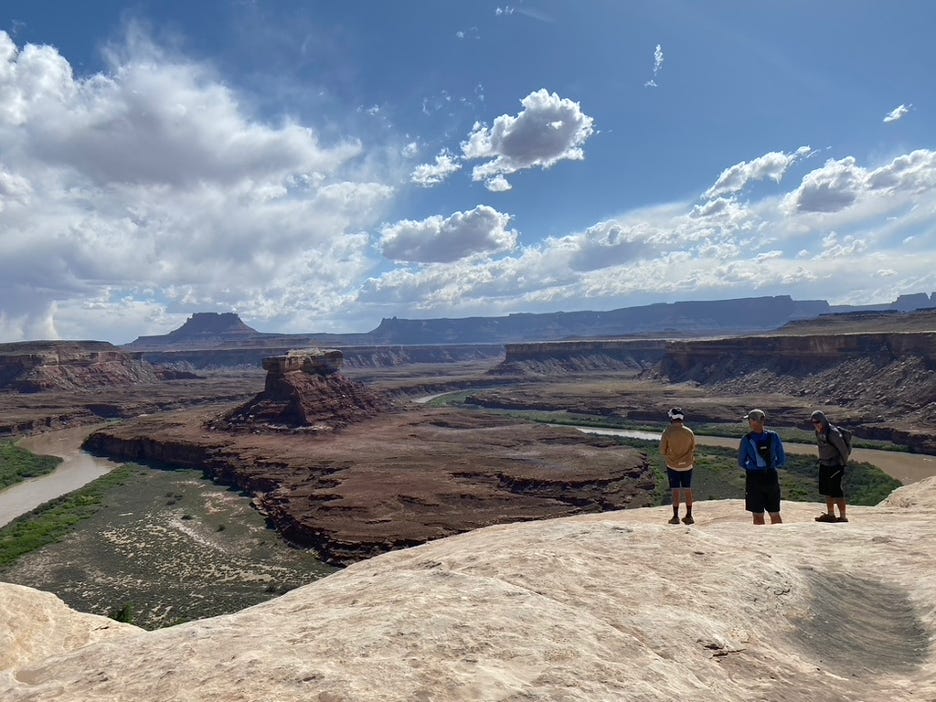
The first time we rode White Rim in three days. This time it is five days. The next time will be seven days. There is an aura about the place that draws you farther and farther in as you spend more time there and progress through its twisty uneven vast, uninhabited ancient terrain. A metaphysical state of mind emerges. The longer you are out there, the more of you it absorbs. You embrace the landscapes, the solitude, the sense of wilderness and enormous sky. The quiet. The stillness. Though everything is changing, one grain, one rock at a time. Some riders bomb the White Rim Trail in one day as a test of endurance and a race against time. We were trying to slow time down with our longer duration ponderous ride.
You can sit for hours and just inhale the experience. There are no outside connections to distract you in this place. It creeps into your deeper senses. That’s when you begin to shrink. You become smaller every day, until you are a peddling wisp, carried by the winds across unending rock surfaces. Massive towers of rock appear on the horizon, and you slowly move toward them hour by hour. Then pass them by, almost like a sea voyage. Your friends are with you in a quiet conversation, then they disappear on the narrow trail in the distance. Within minutes, they are barely visible on the horizon. You are left alone to contemplate.
Each night you pitch your tent, find a place that won’t be a stream bed in a desert monsoon in the middle of the night. You zip your tent shut to keep out the sand and any curious reptile. But the wind comes up suddenly. Our tents are exposed. You lie there and listen to the wind gusts, beginning to surge over 60 miles per hour, pulverizing, and shaking your tent, sand whipping through the air, hissing under the rain fly and through the bug screen, a fine silt like dust settling on all things inside the tent. Your face is covered in dust. You brush it off. But it keeps coming. The tent vibrates and surges in the powerful wind gusts. You wonder if the next gust will be even stronger, burst your tent structure, send it whipping like a banshee in the night. But in the end, it holds up. It resists the wind demons.
At midnight, the winds disappear. The night becomes peaceful, with a full moon gliding overhead. Sometimes, in the time of the new moon, there is no illumination out here. You can lie back and plunge into the Milky Way, to depths you had never even imagined. You fall back asleep, though the slightest sounds that would be unrecognizable in your everyday life, are suddenly amplified in the absolute silence and stillness.
You hear stories from the guides at night of indigenous peoples crossing this land since before time was measured, the incredible journey of John Wesley Powell’s 1869 expedition down the Colorado River into the great canyons below the White Rim, and as we ride farther along the Green River, folklore has it that the area across the river was one of the most remote hideouts of Butch Cassidy and the Sundance Kid. But all these stories end the same. Everybody is just passing through, nobody stays.
There is something anticlimactic about the final day of the journey around White Rim. It’s like decompression at the end of a deep dive. You are just trying to get back to the surface. You start to sense it as you wake up at sunrise and breakdown your tent. Thoughts are creeping in about the transition ahead, back into normal life. Your thoughts are not in the moment as much, not as expansive, not as metaphysical as they’d been the last four days. You are anticipating things ahead. Mundane things. Being more practical. Maybe you check for a cell signal. You ride down along the river and lose the infinite horizons but gain more close quarter vistas, nearer to the water. A sense of completion is starting to sink in.
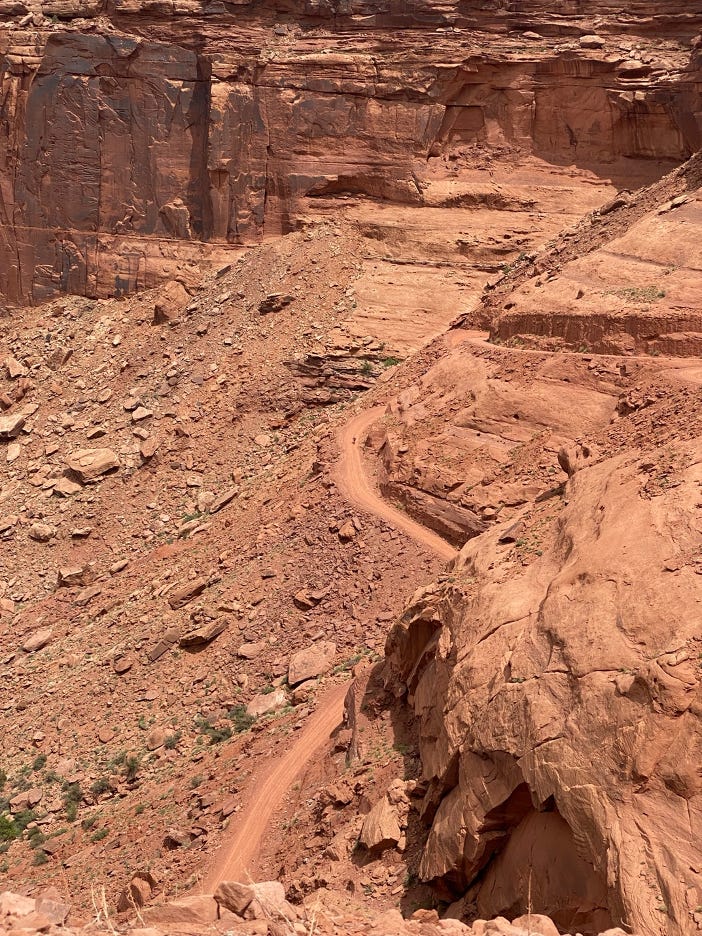
But still, in the back of your mind, is the ominous, 1,200 foot elevation climb up from the Green River that is just ahead. The Mineral Bottom switchbacks will lead us all back to the top of the canyon at Island in The Sky. It is a somewhat daunting climb at the end of five days. Not as steep as Murphy’s Hogback or Hard Scrabble Hill, but arduously long and in direct sun. One last time, you become a tiny spec as you begin the climb up Mineral Bottom’s red rock canyon. You just start spinning and don’t look up too many times. The cadence becomes a meditative state of mind. You center yourself in a position of core balance and crouch low. You reach the switchbacks. You know you will reach the top. Just keep spinning the cranks. Upper body steady. It takes a while. Then you get there. You look back down the cliff and can see a couple small specs also spinning up the red dust roadway. And one by one, all the riders appear and regroup at the top. Food and drinks are waiting. While loading the bikes on the van, Maggie mentions that they are planning a seven day White Rim Trail ride next season. My mind is already there!