
Exploits and Quotes From 'The Dell Pilot'
My great grandfather, LeRoy Gates, was one of the first river pilots in The Wisconsin Dells. His legendary exploits established a tradition of river touring in the 1850's that still exists today.

I visited The Wisconsin Dells in August 2017 to connect with some of my family’s history in that region. My great grandfather, LeRoy Gates, is credited as being the first river pilot to open up tourism in the Wisconsin Dells waterway. That was in the 1850’s. His name is carved into the rocks of the river and a bronze plaque recognizes his piloting. The day I was there, I stepped aboard a small river boat in the lower Dells and told the skipper that LeRoy Gates was my great grandfather. Surprised, he went on to tell me some of the folk lore spun from that era. He knew the story.
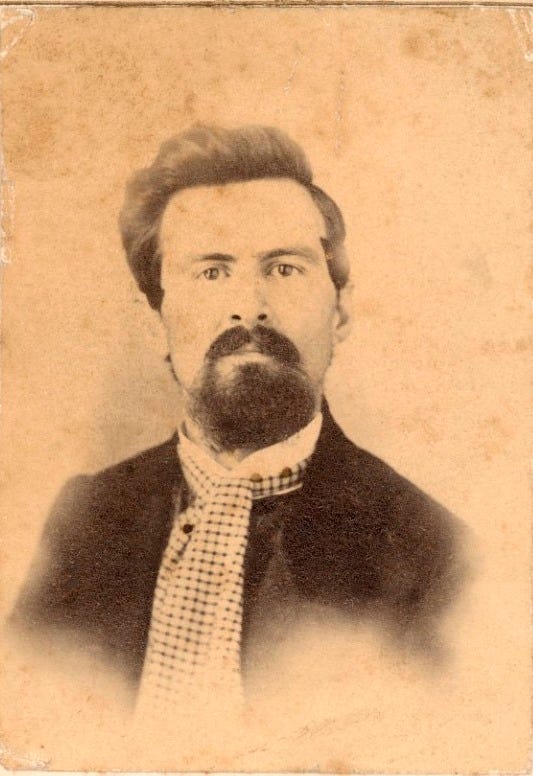
LeRoy once described his own westward adventures as a teenager. His family had arrived at The Wisconsin Dells from Pennsylvania by horse drawn wagon when he was 18 years old. They spent a lot of time in the outdoors during that period.
He wrote, “We reached the Wisconsin Dells, July 27, 1849, finding our way to the banks of the weird, rocky chasm by means of cutting out our road through a thick growth of hazel brush, oak, poplar and a sprinkling of ironwood and butternut.”
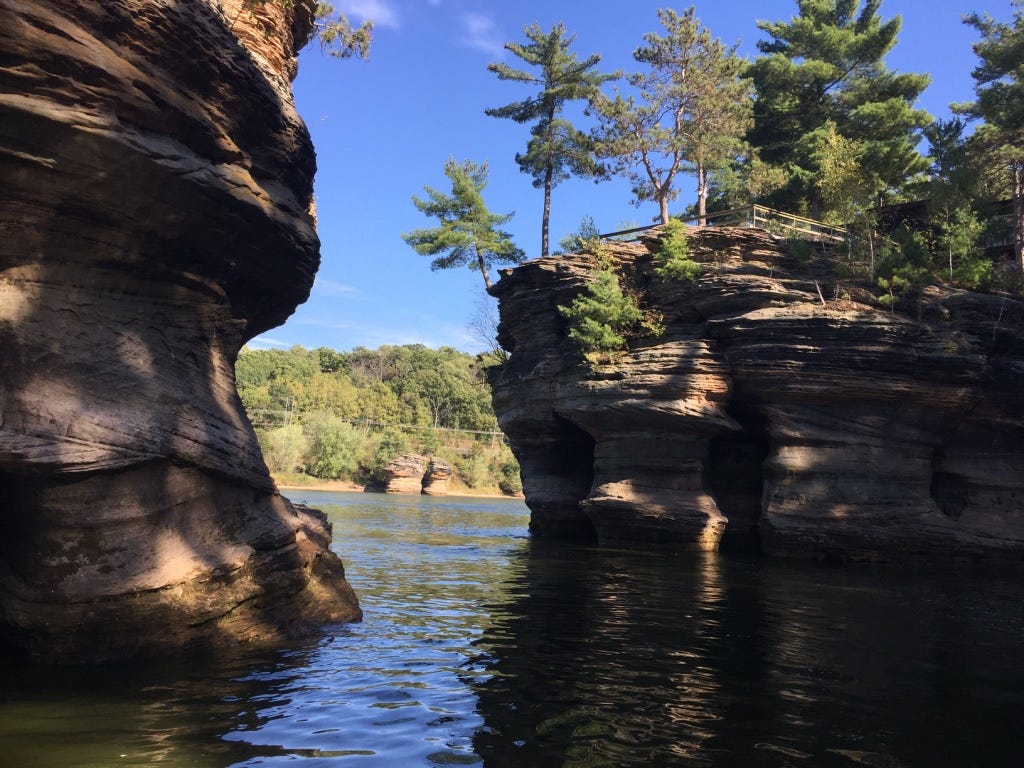
The family spent the next several weeks sleeping out, under the oak trees and the stars. That summer, LeRoy landed a job piloting lumber rafts down the Wisconsin River. He possessed a natural talent for navigating the rivers and established a reputation as a daring river pilot, guiding the lumber rafts through the five mile long, rocky passages of The Dells, a natural, twisting waterway with smoothly formed sandstone rocks jutting up from the riverbed, spiraling in obtuse shapes, with layered sediment rings that inspired the imagination. The formation had been sculpted by water and time. Some of the rocks rose almost two hundred feet above the water.
LeRoy ran white water trips through the narrows of The Dells, in the springtime, when the rivers ran wild with run offs of melting snow and ice, churning down from the interior of Wisconsin, headed for the Mississippi River. Crowds would gather along the river’s edge to watch LeRoy gamble his skills against the torrents of white water that roared down through The Dells. He sometimes wore a top hat and dinner jacket, for effect.
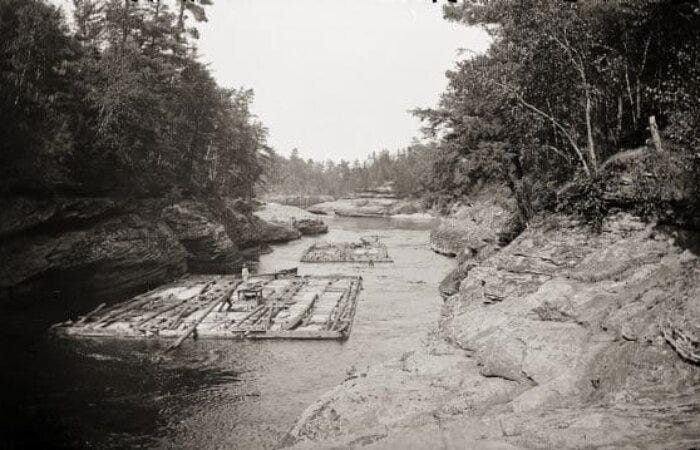
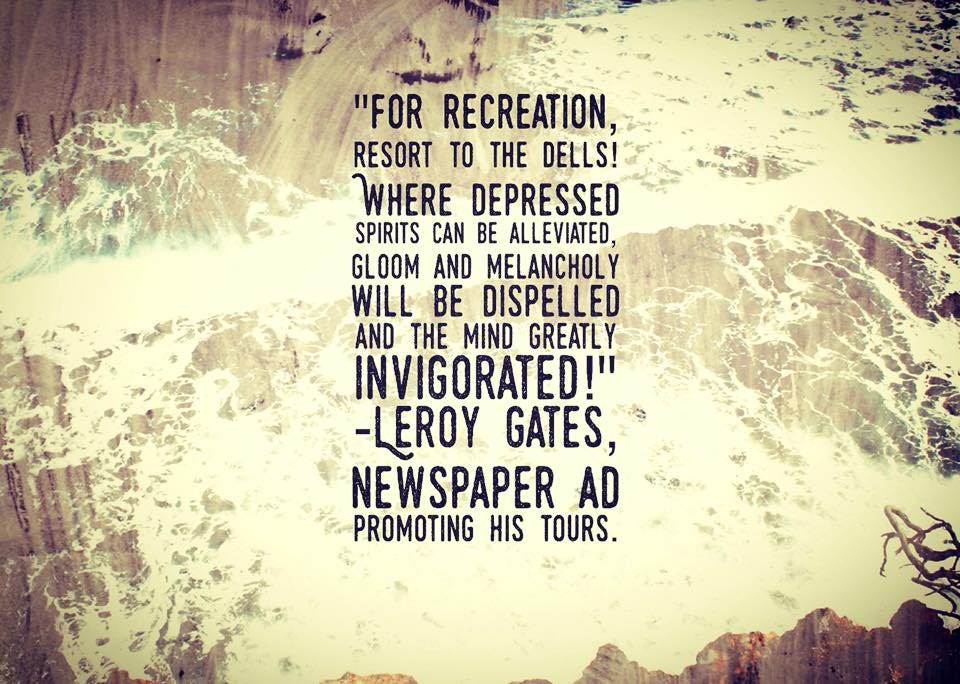
In the 1850’s, he turned his river knowledge into a private business, offering tours of The Dells. Regional historians say that LeRoy would advertise rowing tours on the river, then hand the oars to the customer and sit back and describe the natural history of the river environment as his customers plied the oars.
LeRoy had also been a literary correspondent for the Milwaukee Sentinel, the Chicago Inter-Ocean and the New York Tribune newspapers, contributing articles under his pen-name of The Dell Pilot. He painted landscapes and established a local tintype portrait studio, later sold to H.H. Bennet, the renowned photographer of The Dells.
Gates wrote feature articles about Wisconsin’s hop industry and was an industry expert and investor in hops at the time. Because of his extensive hop knowledge and widespread readership among the region’s newspapers, Northern Wisconsin hop farmers asked Gates if he could recruit six thousand women, girls, and men to pick hops. He accepted the challenge. He spent several weeks canvassing the region and eventually brought six thousand workers, mostly women, to the hop fields of Wisconsin, by railroad, waterways, and stage-coach. It was the one job that women were paid equally to men.
While aboard a train at Kilbourn in 1867, the Milwaukee Sentinel editor wrote:
“Coming from Milwaukee, a few days ago, while comfortably enjoying a cigar in the smoking car, the train stopped at a little station−−there they were, and in they came−−a thousand (women) we thought, but the recruiting officer said there were but six hundred−−a thousand were coming on the next train. The major general of this division of the army of hop pickers was Leroy Gates, who makes the unsuspecting public, who read the Sentinel, believe that he is a Dells pilot. Pilot he is, but not of logs or lumber−−he pilots the wearers of calico and crinoline to the fields where the hops do grow. It broadens human feelings to know there are so many lively girls in the world, and beer will be none the worse for a view of the hands which pick the berries, that give it its bittersweet.”
During a powerful flood in the spring of 1866, LeRoy wrote about the historic flood waters and the power of the Wisconsin River moving through The Dells. The flood destroyed the bridge that his father had famously built in 1859. His father had been brutally murdered by outlaws the year before the flood.
The Dell Bridge stood sixty feet above the river. His father had hoisted the giant timbers that spanned the narrow canyon like a six-story building. LeRoy had stood at canyon edge and witnessed the historic 1866 flood that descended on the Dells that spring, as the twelve hundred foot wide, thirty-foot deep Wisconsin River flowed powerfully into the canyon, which was just fifty feet wide at the Narrows, below the Dell Bridge.
LeRoy wrote, “ … While approaching the Narrows, a heavy roar, similar to that of the Falls of Niagara breaks upon the ear. When once upon the brinks of the chasm, the mind becomes enchanted in confused wonder with the sublime and majestic scene. The iron-colored waters, surging, tumbling, heaving and foaming, charging, lashing and frothing with a hellish and gigantic fury, sending up frightful, angry billows, opening into horrible dark yawning valleys between, forming into mighty vortexes, and sending up their awful bellowing roar, echoing to the very heavens, is a scene to grand for my feeble pen to portray. As the water is now falling, probably never after today, within the present century, will be man be permitted to behold this scene again … This morning the Dell Bridge fell with a tremendous crash, and in a few minutes was lost to view in the boiling, seething flood. Several persons crossing had barely reached the end when it gave way, and it was with the greatest difficulty that they escaped with their lives.”
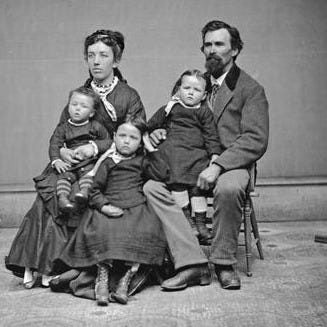
Several years after the flood, LeRoy and his wife Kittie continued on their westward journey, moving their family to Humboldt County, California, where his older brother had migrated years before.
In 1982, when I was researching an old redwood logging ghost town - Falk, California - I found my great grandfather’s name listed among logging town employees at Falk. That book would become Falk’s Claim - The Life and Death of a Redwood Lumber Town.
While in Humboldt County, LeRoy continued to spend time on the rivers. He wrote an article in 1883 for the San Francisco Examiner, that was syndicated to other news papers across the country. He voiced concern about the destruction of the salmon runs on the Eel River in Humboldt County and the possibility that salmon would become extinct.
He wrote: “ … the seines are kept running night and day, and the streams are swept from bank to bank as rapidly as possible when the fish are sufficiently plentiful … this is continued without rest except for a limited period on Sunday … The fishermen generally provide themselves with a fine meshed net for young salmon and a large meshed one for grown fish. The average catch of the young salmon on the Eel River, at the best period of the season, has been known to reach 20,000 a day. Sturgeon are fed to hogs, given away and even thrown away. The fishermen do not want them in the river to bother the seining and are cleaning the river of them as fast as possible.”
The Wisconsin Dells has retained its remarkable allure since the 1850’s when LeRoy founded his river tour business. The region today hosts 4-5 million visitors annually.
jhg - 2017
I will write about the murder of LeRoy’s father (my great great grandfather) at a later time. The vigilante action following his murder, was notable in Wisconsin history.